Saturday, 21 September 2013

Garlic at the Equinox

Over at Fahrenheit211 a personal explanation of why a person would spend precious time tracking stories with no financial reward and, it sometimes appears, little effect on the world.

In response I give you.....garlic.

Seeds and seed bulbs harvested for next planting

Mr Raft has just harvested several large bulbs which are being used, stored, admired and generally enjoyed.  There will be garlic with our Yuletide dinner.  I might see about putting a few prepared cloves in to oil as that is another way of storing them. 

They came to be planted as a  result of a suggestion by another writer known for his sunny disposition; the unmissable Mr Ishmael.   He said out that planting garlic is easy - you just put a clove in the ground and wait.  He also mused that preparing rhubarb in syrup was intrinsically rebellious, reminding us of skills which we once had.

Mr Raft has also let some bulbs go to seed for the next generation so I'll pop them in the earth now in the belief and expectation that there will not just be this autumn but another when the wheel of the year has rolled all the way round, through all those moons.  

Blogging also has to be about optimism, a belief that any small act of defiance is better than none.

H/T JuliaM at  Ambush Predator for the link to Fahrenheit211

Wednesday, 18 September 2013

Things I never thought I would write (2)

Hot on the heels of Yasmin Alibhai-Brown,  Julie Bindel steps out, pausing only briefly to pour a little well-deserved scorn on the sister hood for having dithered about the veil for years.  Then she gets down to it:
the niqab has nothing whatsoever to do with freedom or choice. The drive for its acceptance comes from male hardliners who have no concept of liberty and who use women as a means of extending their power.
Cleverly, they exploit the fashionable western language of ‘anti-discrimination’ to achieve this end. Anyone who calls for a ban on the burka or the niqab can often find themselves conveniently branded culturally ‘insensitive’ or ‘racist’.

I believe the goal of such men is cultural totalitarianism, not the freedom for people to express their faith through the way they dress. Veiled women have become a sort of human shield in the advancement of the Muslim fundamentalist agenda. 
This is Bindel, in the Daily Wail, and she is getting some support in the comments. Never was such times.

Monday, 16 September 2013

Things I never thought I would write (1)

Yasmin Alibhai Brown wades in to the argument about full-face coverings and backs up the Tory MP Dr Sarah Wollaston who has objected to the control over British public life which it symbolizes.

It is important to read her because she is going to be slated by her own kind for her robust stance. So just this once, let's hear it for Yazzer:
when Muslims wilfully create problems and build barriers, anti-racists and egalitarians have an absolute duty to engage with them critically and in good faith. I know frank engagement is avoided because it gives succour to the EDL, BNP, neocons and manic anti-Muslim atheists. I, too, have to think hard before penning columns like this one. In the end though, I don’t think we should abdicate these grave responsibilities because so much is at stake.
Brave women.

Tuesday, 10 September 2013

Bug-be-gone

In an effort to discourage insects I have tried burning citronella candles but the quality of wax is variable. Some expensive ones still smoke even when the wick is trimmed every hour or so.   Googling to find an alternative, there has been  academic research on the subject and this is the basic result:

- reed diffusers are many times more effective than candles
- the smell which best deters insects is not citronella but rose geranium (that is, a variant of geranium, not roses, although there is some resemblance in the perfume).

I do not want to spend a fortune on diffusers but I'm willing to punt a few pounds on avoiding mosquito bites.   I therefore obtained the following

- A packet of 8 reeds which were down to 50p
- a jam jar with a lid
- Odd oil which was no longer suitable for cooking - a lurking bottle of almond oil and a lonely splash of corn oil. Which ever it is, the oil should not have a strong smell if its own. Baby oil is OK, though.
- surgical spirit or other solvent such as vodka.
- a bottle of geranium oil and one of citronella as I do not like geranium on its own. 

Together the perfume oils should cost about £12 and you may be able to find them much cheaper. Any health store will have them.

Mix together the geranium oil, the citronella oil and the cooking oil. Exact quantities do not matter but two small bottles of essential oil will strongly scent at least half a pint of base oil.

Punch 8 holes in the lid of the jar (I used a pointy thing from the screwdriver case and hit it with a hammer)  such that the reeds can be inserted. You could put them straight in the jar but if it fell over the gunk would go everywhere.

Put half an inch of surgical spirit in the bottom of the jar, then top up with as much again of the scented oil.   The oil does not dissolve perfectly in the spirit but they stir together well enough to soak up the reeds.   Some people use vodka instead of surgical spirit which would work but is not as cheap.  On the other hand, at least it doesn't smell of surgical spirit.

Put the lid on the jar, insert the reeds, give it a gentle swirl to encourage the oil and spirit to mix up again, and wait.  Reverse the reeds after a few hours to start the diffusion properly.  You will know it is working because the place will smell like hospital flowers but it is not a bad smell - just peculiar.  You  would not want to dab it behind your ears.  Indeed, you must label the rest of the oil carefully to make sure it does not get confused with cooking oil.

An inch of the mixture in the jar will last at least a month which is bad news if you hate the smell but I can confirm that it has dissuaded all but the most determined bluebottle from coming in.  There is enough oil to top up the diffuser for about a year, meaning the cost of a home-made insect repellent is a little over £1 per shot maximum compared to £10 commercially.  Give the jar a swirl every now and then to re-mix the solvent and oil.

After about two days the stronger smells go and the remaining level is not noticeable to humans - just a lemony background note - but the insects seem to stay away. 

It is worth sticking the jar inside a prettier container - say, a plant pot or jug  - because otherwise it looks like you've gone all Howard Hughes and are displaying your own urine samples.

Saturday, 10 August 2013

Colover Crisis

Sometimes, just one word chosen tells you all you really need to know.  In this case that word was 'predatory' .

Neil Wilson, 41, had admitted sexual activity with a child of 13. The trial had been held, he had pleaded guilty and was entitled to consideration at sentencing for his cooperation with the authorities and his recognition that he had been entirely in the wrong to groom the child in order to encourage her to perform a sex-act on him.   He had moved from Romford, the place of the offence, to York, suggesting that he had wisely moved away from the victim. 

At the sentencing hearing all these  facts were already agreed, the defence had already had all the disclosure it required, and the defender, Rebecca Blain - a solicitor advocate - was able to make her case that her client was very low risk and could therefore be considered for a non-custodial sentence.

That was for the judge, his Honour Judge Peters QC sitting at Snaresbrook Crown Court  to consider.
Summary So Far

- This was a sentencing hearing.
- There was no dispute about the facts, there was a guilty plea which had been accepted.
-  The convicted person had a representative who was the proper person to make decisions about what should be put before the judge from her client's point of view. The defender already had all the disclosure they needed to enable her to do that job.
Then things went weird.

The prosecutor, Robert Colover, an experienced barrister was appearing for the CPS.  His job at the sentencing hearing at Crown Court is specified within the CPS document:
The Role of the Prosecutor at Sentencing
The prosecution advocate represents the public interest, and should be ready to assist the court to reach its decision as to the appropriate sentence. This will include drawing the court's attention to:
  • any victim personal statement or other information available to the prosecution advocate as to the impact of the offence on the victim; 

Instead of representing the public interest Colover suddenly took it in his head to try to act for  Wilson, who was not his client, and decided on a strategy of blaming the victim, rubbishing her character, saying it did not much matter as she was already damaged goods, and that in any case the hot little minx was gaggin' for it.
“The girl is predatory in all her actions and she is sexually experienced.
“She appeared to look around 14 or 15 and had the mental age of a 14 or 15 year old despite being younger than that.
“There was sexual activity but it was not of Mr Wilson’s doing, you might say it was forced upon him despite being older and stronger than her.”
This is not a victim's personal statement. It is victim-blaming.

Note please that the appointed defender did not consider that was what she wanted to say on behalf of her client.  Rebecca Blain did not think it necessary to discuss the victim.  If she had done so, she would have had to give notice of that as the protocol for this is also available from the A-G's office
Pleas in Mitigation

The prosecution advocate must challenge any assertion by the defence in mitigation which is derogatory to a person’s character, (for instance, because it suggests that his or her conduct is or has been criminal, immoral or improper) and which is either false or irrelevant to proper sentencing considerations.
So not only did Colover try to act for the wrong person, he did so by playing an antique 'blame the victim' card in defiance of the properly appointed defender and the A-G's advice.
 
At this point Honour Judge Peters QC failed to spot that Colover had strayed disastrously from his brief.  Instead of politely ignoring the irrelevant remarks from the prosecution and concentrating on what the defender wanted to put forward for consideration,  Judge Peters decided to take Colovin's remarks on board as if he was acting for the defence and repeated:
 On these facts, the girl was predatory and was egging you on.
The only explanation I can think of for this is that since Colover is well-known and deeply respected, the judge simply accepted what he said instead of recognizing it for the aberration it was. However, another explanation might be that Judge Peters failed to recognize that the female solicitor as the relevant defender, what with her bein' a girlie and moreover one 'o them new-fangled solicitor advocates.

Rebecca Blain is listed as a partner at DPP Law and appears on the duty solicitor rotas.   The practice in which she is a partner gives no profile, possibly as a protective measure although she has done nothing other than her job properly in accordance with the A-G guidelines. 

Summary

Robert Colover, representing the public interest, forgot who he was acting for and indulged in victim-blaming which, if the defence had tried it, would have been his duty to challenge as per the A-G's advice. Possibly he was unwell or became hopelessly confused as he more commonly works for the defence.

Rebecca Blain, defending,  did her job properly.  Due to irrelevant remarks made by Colover and the Judge, her client is now facing more uncertainty rather than having the case settled as the sentence may be reviewed.

His Honour Judge Peters QC, despite being a QC, became confused as to who was making the plea in mitigation, possibly because it was a lady solicitor.-advocate.  Since the contentious and irrelevant comments came from a hitherto respected barrister who more commonly appears for the defence, the judge threw the legal advice out of the window and joined in with the victim-blaming.   His is  the worst failing because he is supposed to be running that hearing. 

The victim has been blamed by a prosecutor and a judge, which will do wonders for encouraging other victims to come forward.

Perhaps it is not only fear of being called raaaaycists which has made the CPS tardy in applying the Sexual Offences Act 2003 to deal with grooming gangs.  It appears they have been fighting uphill against a judiciary which regards preying on children for sex as as not really a proper crime at all.

Wednesday, 3 July 2013

Job of the Month - Miniature Steam Railway Engineer/Driver

Trago Mills Railway - picture from Trago Mills website

Trago Mills, my favourite store in Devon and Cornwall, offers this beauty at their family fun park in Newton Abbot, if you have the engineering background and want to change your life:

Miniature Steam Railway Engineer/Driver Required
We are looking for an energetic, enthusiastic and mature person to join the team in our Steam Railway Department as an engineer/driver.

The successful applicant will possess a background in engineering including the use of lathes, milling machines and general workshop tools. This will enable them to help maintain and refurbish our collection of steam and diesel trains including rolling stock and track. Train driving experience would be advantageous but is not essential as full training is provided. 

In the first instance, please call 01626 821111 to request an Application Form.
Please then complete the Application Form and return it to:
David Jennians, Leisure Manager,
Trago Mills,
Stover,
Newton Abbot, TQ12 6JD.
Here is where you'll be working  

Thursday, 27 June 2013

Careers Advice for Under-cover Operators

PC Huggable
 As the row over under-cover police having sex with activists rumbles on, the Usual Caveats says
prosecutors would decide whether operatives who had sexual relationships were breaking the law.
(source: Daily Mail Tuesday, Jun 25 2013)
This is worth watching because a series of recent cases has shown that obtaining consent by deceit may render the consent ineffective and leave the convicted person open to sanctions such as being on the sex offenders' register.   

The deceit in these cases was of a particular kind: pretending to be male to obtain sexual contact.

First a Scottish case in June 2013, that of  Christine Wilson.   Don't get side-tracked by the age- differences or  the gender identity disorder.  Both of these facets are important but what is being examined here is what constitutes deceit such that it can give rise to a criminal prosecution and conviction.
At a previous hearing, Wilson pleaded guilty to two charges of obtaining sexual intimacy by fraud and was put on the sex offenders’ register. This is a fraud case as it is Scottish law.

An earlier Scottish case in 2010, against Samantha Books was eventually dropped  by prosecutors when a witnesses refused to cooperate, leading another complainant to criticise the prosecutors.

Moving south of the border, in March 2012, Gemma Barker in Surrey used false male identities to have sexual encounters with girls.  She admitted two counts of sexual assault and one charge of fraud. 

Finally, in June 2013 the sentence against Justine McNally was reduced as she admitted six counts of sexual assault by penetration. Her listing on the Sex Offenders Register was reduced to ten years. (McNally is Scottish but the offence was in London, so the case was heard in Wood Green under English law).

As these last two are English law cases, they were tried as sexual assault.  Defendants have usually chosen to plead guilty so the points of law are still open to interpretation if another case happened to go to appeal.  Justine McNally's conviction was upheld but her sentence revised.

.......

Back to the police. I'm going to assume most of the personnel involved are men although there might well have been female under-cover(s) operators.  It is alleged that some of them engaged in sexual intimacy under false identities and for purposes other than those they claimed at the time.

The gender misrepresentation cases put down one marker for what will be regarded as making consent defective because it has been obtained falsely. Another is already unambiguously covered in legislation.  If the complainant had a mental disorder impairing choice such that they can be brought within the definition of  s.34 of the Sexual Offences Act 2003, then the person who deceived them can be prosecuted.  
 
A further restriction was defined in 2007 when Giovanni Mola was unable to argue he had consent in order to avoid a conviction based on reckless conduct (Scottish case).  He failed to inform a lover that he had HIV, thus impairing her ability to make an informed decision whether to have sex with him.  A summary of other cases is here

Prosecution of cases around transmission of HIV have abated as a matter of public policy; the emphasis has gone on to prevention as it was feared that the prosecutions were deterring people from seeking treatment. The policy remains controversial.  Opinion is split on whether agreeing to sex means agreeing to factors unknown, or whether it is a conditional consent depending on what is disclosed at the time.

Consenting to sex does not mean consenting to everything even in the ordinary course of events. There is a point at which an act may become abusive and outside the scope of consent.  Normally this is thought of in physical terms but it could be psychological.  But for ignorance that the person was married/had a disease/was a paid infiltrator, the complainant might not have agreed to sexual intimacy.  

It is argued that deception is justified in order to infiltrate organisations "such as environmental groups".  Fat lot of good that did.  Mark Kennedy should have been putting it about in the Climate Unit of UEA, or at least offering Chris Huhne a ride. He has failed to prevent the country being peppered with taxpayer-subsidised bird-mincers. 

As David Morris of the McLibel trial said when it emerged the co-writer of the leaflet which caused all the trouble was Bob Lambert, an undercover policeman, 
"All over the world police and secret agents infiltrate opposition movements in order to protect the rich and powerful...."
Look how well that went. McDonald's ended up paying lawyers millions of pounds, only half-winning a technical case and smashing their reputation.  Whether they asked for the Metropolitan police to act as political agent provocateurs has yet to be examined.  

Wednesday, 22 May 2013

The Death Penalty

There is a parallel between the 1965 vote on the abolition of the death penalty and the 2013 vote on same sex marriage. 

The vote on same-sex marriage went 366 in favour to 161 against. That is, approximately two thirds of the House supported the government. The larger part of the one-third opposition was not the Opposition at all; it was the government's own party.  In a free vote, the government only got its bill through by doing deals with the party which it nominally opposes.
 In 1965 the Labour MP Sydney Silverman, who had committed himself to the cause of abolition for more than 20 years, introduced a private member's bill to suspend the death penalty, which was passed on a free vote in the House of Commons by 200 votes to 98. The bill was subsequently passed by the House of Lords by 204 votes to 104.
Source: wiki, which goes on to detail the exclusions and parliamentary technique used to present abolition as suspension.  The split, again, was a two-thirds for change, one-third for the status quo.  Note also in subsequent developments that there was a deadline; the abolition had to be enacted in English law before a European-set deadline. If it had not been done then the authority of European law would have become much more visible to the voting public.  As with same sex marriage, the impetus is not from within Britain but to disguise the fact that the real power comes from outside it. 

Despite the parliamentary feeling that the argument about the death penalty is done and dusted, no politician would dare put the matter before the public.  The public is much less convinced that there is any point in keeping Ian Huntley breathing, and it is about to ask the same question of David McGreavy who has failed in his bid for anonymity.  Despite what some people claim, the law does not lead public opinion as much as they would like, nor is it clear that we get good law when it tries to do so.

English law jumps before it is pushed in order to disguise that hand of the pusher.

Sunday, 12 May 2013

Plays of the Century

A pair of plays bracket the boom years of the end of the 20th century.

The first is Glengarry Glen Ross, the David Mamet Pulitzer Prize winning masterpiece which had its world premier in London in 1983.  This is the eve of the spread of the mobile phone and the salesmen in the seedy office do not have them, not even smoothie Ricky Roma.  Consequently they can do nothing when the telephone handsets are stolen. 

In pitiless observation of their language and values, Mamet exposes what they don't want to face; they couldn't do much when the phones were there, either.  They just like to think they can.  The numbers don't stack up; the junk estate they manage to unload on to fools is still not enough to pay for the time they spend hunting for the next mark. 

They like to think of themselves as natural raptors but at that point in history there weren't enough stupid, juicy mice to sustain them.   They believe their Jedi sales skills will work for them so long as they are allocated the Glengarry Glen Ross leads but there is no good reason to suppose that those leads even exist.  

The office manager thinks these leads are what the firm has bought. He has to distribute them to the salesmen who can best convert them in to sales as shown on the competition board. But there is no reason why there should be a pool of convertible leads for swampland. We never know if the land itself is real.  It's possible that the leads are just a mirage the firm has bought. It's possible the firm's owners know it is a mirage and are playing their own game of pretending to have a profitable company.  The only time the leads have a quantifiable value is when they are stolen and palmed-off on to the next desperate re-seller.

The only people who get anything out of it are the Nyborgs, a couple who like having the attention of a salesman and can do so in safety because it doesn't matter what they sign; they haven't got a bean and the contract isn't enforceable.

In 1987, when Oliver Stone and Stanley Weiser created the character Gordon Gekko for Wall Street, they rooted him in the land speculation of the 1970s, when the early-entry gamers had parceled-up and moved on their junklands to intermediaries.  Ten fictional years later, this office is a long way down the pyramid where Gekko is the pinnacle. It is the last step before the weak James Lingk (weak lingk, geddit) who is induced to sign a contract by Roma. No matter what the salesmen think of themselves, Mamet has positioned them at the bottom of the pyramid of losers, unless they manage to find the one bigger loser beneath themselves - and even then, the law will help their prey escape.

Mamet was appalled to find that far from taking the play as a warning, he had accidentally created a feedback monster and that this was used as a training manual.  The latest incarnation is the Alan Sugar vehicle The Apprentice, where a group of young people are encouraged to shred each other for the edification of the viewing public.  Glen Sugar.

The second play is Enron, Lucy Prebble's explanation of the collapse of the company.  Although the dialogue is wonderful it has to do more technical exposition than Mamet had to because of the breath-taking scale of the fraud.  How could something that big be hidden?   Here we see the same kinds of   people, still selling, still voluntarily blinding themselves to economic reality, only now they have a great deal more money because the boom years have persuaded them they are fantastically clever people instead of what is nearer the truth: they have been unbelieveably lucky.

The fictional Ricky Roma gave philosophical soliloquies which justified his actions; the fictionalized Jeffrey Skilling is similarly given speeches with queasy half-truths in them. Bubbles of inflated value have made things such as railway construction possible and we wanted it all to be true .

Prebble wrote a show which is geared for the modern stage using surprise motifs which wouldn't work in film.  Whereas Glengarry Glen Ross is a realist drama, Enron owes more to forms such as Greek tragedy,  a big canvas of tragedy compared to the intimate study of misery.  Mamet takes small people and enlarges them in to monstrous detail, Prebble has to take a huge event and find a way to contain it on the stage.   Alas, you'll probably have to hope somebody stages it near you or buy the script as there don't seem to be any listed productions at the moment.


This week it was announced that Jeffrey Skilling may be able to negotiate a deal which will see him out of prison earlier much earlier than his original sentence demanded.   Although he presided over the biggest bankruptcy in US history, his mistake appears to have neglected to be a bank.  Then he'd have been bailed out by the tax payer, probably still had his job and possibly still have been given a bonus while losing money.

Thursday, 9 May 2013

Tall Ship's Official Seal

This is the Official Seal of the tall ship Mercedes, a brig on which I had the honour to sail at Easter.


When I say 'sail' I mean I sat there as excited as a ship's dog and they did all the rope work and sailing, then we went back to port and had lunch there as it was too fresh to try that on the waves.  I had fish - what else would you eat at sea. 

Mr Raft, who likes roller coasters, was standing on the prow so he could ride the waves outward. I stuck to the midship, me hearties, and watched the land because the potential for seasickness is obvious in us wet-bobs. The journey home was serene as we were running smoothly with the waves under the silence of the sails. 

I can't say that I will ever be a sea sailor but I do love to look at tall ships - doesn't everyone?  The good news is that in late summer 2014 there will be a tall ships regatta in Falmouth where they hope to assemble a world-class fleet of the most beautiful vessels ever built by man. (*).

Here's a video of Mercedes under sail


(*) Concorde is the most beautiful craft ever built by man if you include flying.


Update 15 May 2013

Dates for the Tall Ships Regatta 2014 have been confirmed.   There will be three days of festivities from August 28 and the race will be on 31 August.

Everybody will be able to enjoy the spectacle of  a fleet of up to 50 tall ships coming in to harbour, where the public will be able to see round some of them.  The ships will race from Falmouth to Wight. 

H/T The Falmouth Packet

Racing coordinated by Sail Training International

Twitter updates from Falmouth Tallships Association

Monday, 29 April 2013

Switzerland News

As can be seen from the diagram on My Favourite Wiki, Switzerland is not a member of the EU but in 2000 it signed the Agreement on Free Movement of Persons with the European Union. (Reports the Independent on Sunday)


It's not clear why they would sign that since Swiss citizens appeared to be able to move freely without it, but there must have been some reason at the time.  Perhaps in those balmy pre-9/11, pre-banking-crisis days it seemed like a good idea. Switzerland's majority trade is with the EU so it makes sense not to annoy the customers.  However, it also looks like a surreptitious way to try to get the Swiss to agree, de facto, to something they had already voted against.

Just in case of trouble, there was a safety-clause written in giving the Swiss state the power to restrict entry via a permit system but even that power will lapse.   However, for the moment it has been invoked, capping the numbers of people who can come in to Switzerland from certain states.   As wth all EU-related matters, the power is hedged about with conditions, categories and implementation dates, making it take effect slowly and incrementally.

But the overall pattern is clear: these levels of immigration are not acceptable to the Swiss people and the government has reacted to that.  Since the complaint is reported by the Independent as immigration pushing up house prices as a result of business expansion and Switzerland being a very attractive place for businesses to relocate, it can be assumed that the squeeze is being felt by middle-class voters.  The BBC however, reports this as if the concern is about the influx of lower-paid workers . 

The doctrine of free movement of people is good for the businesses and the individuals who move to secure better conditions for themselves.  However, the doctrine takes no account of the way this also imposes a disbenefit across the rest of the society. Demands for infrastructure: transport, housing, policing, health services and education rise. These have to be paid for by existing taxpayers who may then find they also face greater competition.  Benefit is privatized, the wider costs nationalized.  There can be good reasons for doing that, such as the general benefit of education, but the costs should be recognized properly instead of pretending they don't exist.

The Swiss mode of government includes regular use of referenda.  It is therefore arranging two of them to find out exactly what people - their citizens, not other folk and especially not Germans - want their government to do.

Friday, 26 April 2013

Follies - Pied Pipers

The best excuse for watching a pile of old musicals on DVD is that you are swotting in preparation for a Sondheim.  Then on to Cambridge for the Pied Pipers production of his 1971 elegy on the lost world of the fictional Weismann's Follies.

 
A musical must be accessible and Stephen Sondheim follows this rule but his intricate writing can be appreciated better if you already know about the world he set the story in.  In 1971 this was part of common consciousness but that was itself 42 years ago; there is a danger that a musical about people confronting their own pasts sometime in the 1960s might itself have become a ghost. 

Because he's a genius Sondheim foresaw this and also had some luck in the emergence of the video industry. Old musicals don't die although they sometimes go in to limbo. The references are always available now but he made sure he put enough in to the script even if you have never watched one.  The tour de force of Loveland where the couples collide with their own memories and act out their own personal folly through popular genres of songs is breathtaking but could be baffling if you can't just let go and wallow in the lyrics.  The plot is going on under there, you just have to wait until it re-emerges.  The production has always divided critics, though. I think some of this is simply that Brits are sympathetic to meditations on faded glamour whereas Americans see it as a reproach.

The premise is simple; a reunion of the old Follies performers, most of them female, takes place before the theater is pulled down. There is unfinished business between some of them. It has to be finished that night because there will never be another chance.  Thus the stage is set as a splendid but decayed theatre; high American Gothic.  It is a ghost of the real Zeigfeld Theatre, pulled down in 1966. They will do one last performance. 

Designers Andrew Feathertone and Sarah Phelps get this right when they show the damaged fabric of the theatre. The 1971 designs suggested a space which was was nearly gutted, but that would not distinguish it from any other warehouse. 

Director Jacob Allan has to manage a complicated stage where the memories of showgirls past parade along the balcony like shades of Hamlet's father along the battlements of Elsinore.  The younger selves of the key characters step out of the past either to show us what really happened, or sometimes to show us how they remembered it.  Not necessarily the same thing.

This is not a minimalist production; although there is only one set there are numerous costume changes for the secondary characters and intricate choreography to bring the past and present characters to the right places on the stage, capturing the spectacle of the Follies.  This is particularly successful in the big number "Who's that Woman?" where a tableau flows in to a tap dance which involves all the women, past and present.

As the company is fantastically devoted to performance they all give Sondheim's words the clarity they deserve but two interpretations stand out.  Kirsty Smith as Solange, the French diva (who may or may not ever have been French) conveys all the flinty determination of a woman with her own brand of perfume to sell. She produces a gem in Ah, Paris!, which she delivers just fractionally flat in the correct stage-French style, the method by which millions of people have been convinced they are listening to a sophisticated Gallic chanteuse. Everything about the character is perfectly observed, right down to the dress ring over her elbow-length gloves.

Stephen Waring as Buddy Plummer has to do a superb acting job because unlike most of the other characters Plummer is not a performer. An oil engineering salesman, yes, but essentially he plays the civilian on a stage full of combatants. Even Ben Stone, played by Matthew Chancellor, is a literate, articulate character used to operating on a par with the intellectual elite in society. Waring has to portray the moderately successful ordinary guy, middle-America rather than Washington.    He is therefore given one of the most tongue-twisting pieces to perform in a vaudeville number, The God-Why-Don't-You-Love-Me Blues whilst doing a galumphing chase dance with the fantasy versions of the women who are driving him mad.

Full marks to the Pied Pipers for this ambitious staging.  At time of writing there are only two tickets left so you'll have to lobby them to give it another outing. 

Wednesday, 24 April 2013

Footloose - Irving Stage Company

To the Theatre Royal, Bury St Edmunds for the opening night of Footloose performed by the Irving Stage Company.


Those who know this 1998 toe-tapper adapted from a 1984 dance movie will be familiar with the big numbers "Footloose" "Holding Out for a Hero" and "Let's Hear it for the Boy".  The company has to get the energy up on these because they are the feel-good spine of the story which holds against the very dark background of mourning, fear, and entanglement with a violent young man.

As it was opening night the company was coltish, wobbly on its legs to start with, so it was with great pleasure that the audience could see them hitting their stride as the company orchestra, directed by Mark Jefferson, went through the score faultlessly, sweeping them along.  During 'Holding Out for a Hero' the company began to relax and swing in to it. By 'Let's Hear it for the Boy' they were a unified force on the stage.

The glossy programme (designer Camille Berriman) with thoughtful notes  recounts that the show is animated by the fact that this really happened; a tiny town in Oklahoma had banned dancing and a youth there challenged the edict and won.  The writer and composer Dean Pritchford then built a classic conflict and resolution plot around that. It isn't candyfloss - there's a proper play in there and Shakespeare would recognise it.

The strength of the plot makes great demands on performers.  There is only one unambiguously bad character, all the rest are very good people but mistaken. This is a greater test of acting ability that goodies and baddies; the players have to hold our sympathy especially when they are wrong.  The toughest job on stage is managed by Daniel Bunker as the middle-aged Reverend Shaw Moore, doubly difficult where the musical is performed in a country where the audience may not understand American reverence for Christianity. Bunker carries it superbly as he has to confess to the audience how close he is to breakdown when his whole life is built on his ability to be strong for other people.

Brian Carmack, who really is from Chicago, plays the outsider Ren McCormack, moved from Chicago to a very small town indeed,  one even smaller than Bury St Edmunds.  He  provides a tuning-fork for the company; without this there is a danger of a rag-bag of cod-American impersonation. Accent coach Darian Vomund orchestrated the speaking voices convincingly and exploited Carmack's voice to create a an audible difference between the out-of-towners and the sharply-spoken city boy.

Carmack and Josie May Harrington as Ariel Moore  have to lead the youth side of the story. They must capture how dangerously naive the highschoolers are.  This is tricky for director Sian Couture to pitch correctly as it can all go 'a bit Operation Yewtree'.  Although the Ariel Moore character can be assumed to be over the age of consent, she's  close to it and has tangled herself up in to an exploitative and abusive relationship with a Chuck Cranston, played by Ben Child.

Within the story it is made clear that Cranston is a youth but Ben Child gives him a harder edge which is more credible in its manipulation.  Cranston pretends to be concerned for Ariel's welfare but he knows what he is doing when he goes out of his way to tell the Reverend Moore that his daughter has lied to her parents.  His aim is to inflict as much damage as possible on the family out of pure spite, particularly towards the reverend's grieving wife, played by Angela Grant.

The sub-plot of Rusty and Willard, played by Serena Grant and Ben Musgrove,  requires that both of them bring an audience to its feet, which they do.  Willard's character arc is also demanding. Musgrove has to persuade us he can go from tongue-tied country boy to the spinner of shrewd folk wisdom. He does this via the superb number 'Mama says', full of glorious one-liners set in a slapstick routine. Luckily it has a short reprise after the audience has finished clapping -  we could easily stand see the whole thing again, particularly the line "Mama says the things you believe are the only things you really own". Discuss.

Keeping the stage relatively bare and moving a few props and a little scaffolding, the sets were created quickly by lighting so that the action kept moving. Special congratulations for choreography by Sian Couture and Christine Glancy.   Inspired  use of Achy Breaky Heart resolves the stage in to waves of line-dancing which perfectly express the universal appeal of dance.

Footloose is on until 27 April, so get in quickly.   Don't forget your check shirt and cowboy hat.

Friday, 19 April 2013

Prince Charles' watercolours

Prince Charles has, of course, collected a kicking from the Telegraph for his watercolours, despite obligingly providing them with several column's worth of material to blether about.  There's no such ingratitude here; this blog knows a freebie when it sees one.  

The Prince has published on line a gallery of his pictures.  The gallery begins here.

A serious publication deserves serious evaluation - he's no less entitled to that than anybody else who picks up a brush and allows you to see their work.  Watercolour is a defiant medium; it's just you, a few colours, paper, brush, and a pot of water.  That's all you need to record your world.  It's much less complicated than most other media but technically its a testing one because you have to have it clear in your head what you want to do and then lay it down in relatively few strokes.

Watercolour doesn't give much in the way of second chances; too many revisions and it goes muddy.  Spiritually it is closer to handwriting than painting; it's best if you get it right (write) first time because the corrections are difficult to disguise.   Experimentation is best done on cheaper paper; the idea is to find out how to work the brush and paint without worrying about a picture, then, when you have sorted out the strokes, turn back to reality and try to get the picture space organized.

Watercolour is democratic; it costs relatively few pounds to get going with a decent block of paper, a couple of brushes and a limited pan of colours.  The brushes are the most expensive items but cheap brushes will still get you started. You will be working with materials which any professional would be just as happy to use.  The grandma taking a U3A class starts from the same place as an Academician.

It is therefore interesting that the Prince chooses not an expensive camera but something which links him to every school child and hobbyist in the country.  Moreover, he chooses to pursue that common experience "Wow, I wonder if I could get that down on paper?".  Most of us give up at that point and get out the camera.

The pictures have been grouped by theme and location. It is obvious where his heart is, but for evaluation the question is: has he caught the differing lights in the various countries? How you judge that might depend on how well you know the places.  I think it is obvious from the selection that he is using watercolour as a private record, a way of fixing experience on paper but is not always sure which aspect of experience it would be best to anchor the picture in.

There are choices in any picture when you have only limited time and palette.  A giant major oil painting allows you to try for several in the same picture, but with watercolour you have to make that decision at the beginning and stick to it.  Do you want the structure of the rocks and buildings? Or are you more concerned to always be able to get back to the fleeting sense of light over a landscape? Or you might be more in love with the impossible colours and decide to focus all your attention on the them and their relationship to each other. This might yield an abstract image which structurally bears little resemblance to the thing you saw.  

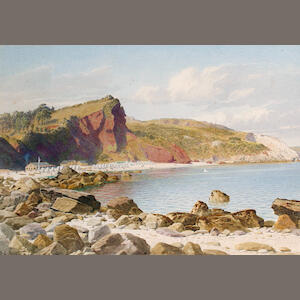
Painters such as Samuel Edward Kelly (below) managed to combine these competing aspects and yet keep the colours clean, but there is also a strand of English watercolours which simply gives up and lets it go all sepia. They often paint decrepit barns and cottages where you'd expect it to be dingy.

Samuel Edward Kelly. Babbacombe.


It is often said that Prince Charles dithers; his pictures express an uncertainty about which aspect he wants.   Since photography has been invented, it isn't strictly necessary to paint a picture for that purpose now. If he picked two high-contrast shades, light and dark, concentrating only on pushing areas of the picture plane back, pulling others forward, he'd find the weight of the rocks compared to the lightness of the air would emerge.  They don't have to be strictly real; they just have to work in relation to each other.

Alternatively, many of the pictures show he is struck with the unearthly intensity of colour but then steps back politely, as if he doesn't want to be caught over-reacting and feels unable to lay down the ultramarine in case someone accuses him of not getting it quite right. The online collection does not show it, but there are times when light around Sandringham is psychotic; the leggy pine tress turn brick-red with slashes of dark emerald needles, the sky turns cerulean blue and the sun blood-drops in to the Wash.  Those are the evenings he should be out on Holkham beach saying this is my paintbox, my picture, and I'll damn well paint it whatever colour I see fit.

Overall  - sound catalogue, keep going, get bolder. There's always some bugger telling you that you can't do it this way, or that you shouldn't try at all. Don't listen to the Telegraph.

Wednesday, 17 April 2013

When I'm 54 - the funeral of Baroness Thatcher

History has limitless time to evaluate her life and effects on British politics; the funeral is the closing of one chapter and the beginning of that process.

The note today is that she was 54 when she became Prime Minister.  She didn't think "I've put 30 years in, I've led this party back in to power, I'll do two years and then plead illness, get a nice little country estate, go and spend some fun time with my money". 

Instead, she did her best to lead the country.   Everybody has their own opinion about how that went, and tomorrow that can be argued about.  But today her example is that being over 50 has its drawbacks but it also has experience, fortitude and the possibility that the greater works may be done later in life because one finally has the knowledge of how to do them.


She has earned her rest.

 ....

 H/T Ambush Predator

Friday, 12 April 2013

Prosecutions for use of Social Media

There seems to be a lot of activity around the subject of investigation and prosecution for the use of the social media.  I think the document people may be looking for is this:

Issued by the Director of Public Prosecutions on 19 December 2012

If your query concerns Paris Brown, who recently stepped down from being a Youth Commissioner for Kent Police, the following CPS clarification may be of interest to you:
where a communication has been sent that is grossly offensive, indecent, obscene or false, there are a number of factors that are likely to mean that a prosecution is not in the public interest.
One of these factors is whether the suspect has taken swift action to remove the communication or expressed genuine remorse.
Brown apologized and removed the items. It is difficult to see any public interest in taking the matter any further.

The Scotsman has some figures which may also be of interest:
Scotland Yard revealed that three police officers have been sacked for misusing social media over the past five years. Allegations linked to the use of sites including Facebook and Twitter have been recorded against 75 Metropolitan Police officers since 2009, with 38 of the claims substantiated.
Disclaimer: this post is merely a link to relevant documents.

.....

Update 1 May 2013

Olswang LLP, who represented Paris Brown, have provided an excellent summary of the case. 

Essentially, the police had to respond to the 50 complaints about a few tweets although they've got plenty of burglaries, murders and rapes to be going on with.

Responding suitably should have taken about a morning to check the published guidelines and note that the material arguably didn't come with in the scope of the guidelines, it had been removed, an apology had been given, and Paris Brown was under 18 so the bar for prosecution is set very high.  They could have asked a CPS lawyer if they weren't sure what the guidelines meant.  Then they could have politely declined to take the matter further.

Instead - and this is what we should be kicking about - they used the mere excuse of complaints of being offended to confiscate property and interview a child under caution.    Then they had to drop any thought of charges since it was obviously a non-starter.  Well done to Olswang for highlighting this abuse of process.

...

It is obviously ridiculous that a teenager has to call in a lawyer to protect her from the agents of the state who should have had more sense than to join in with child-kicking.     Was their purpose in doing so nothing to do with the 50 complaints but rather a convenient excuse to examine communications between a police commissioner and her appointee?   

Following the irregularities in the Andrew Mitchell Affair (which is still being investigated)  there needs to be an independent investigation of the 50 source complaints to see if they were in fact genuine members of the public or if there was a concerted action by either a political lobby, police or those connected to them such as close family. 

Thursday, 11 April 2013

Back to The Minack

The Minack Theatre opened the 2013 season in chilly but jolly form with Craig Johnson's Squashbox Theatre giving morning performances aimed at teenies.


 Children wrapped up against the blow from the sea settled down round him looking like woolly cupcakes round a candle.  The wind was so fresh he had to have an assistant keeping the scenery on the ground. Johnson's nemesis is a sea anemone brought out from his rock pool for our delight, but he's also taunted by an ocean full of limpets, sea-squirts, crabs and his seagull friend, Ruan.


As he takes us through his Cornish world we meet  fishwives, sailors and the enchanting mermaid Morwenna.  I can't tell you what she said - it's a spell, you only know you've heard one - but I can tell you that the man in the next family nearly burst with laughter.  He was a helpless jelly the way a four-year old goes when something strikes them as impossibly hilarious.  She must have reminded him of an old girlfriend.

Squashbox's theatre contains improving elements of education, but you won't notice them as he handles them with a supreme lightness of touch.  If it gently reminds children - and adults - to put litter in the bin  then I'd much rather it was done this way than  by repeated ugly nagging, which doesn't work.

If you don't have or can't borrow any children, go anyway because Craig Johnson does magic before your very eyes, conjuring an alternative reality out of his imagination.

 The Minack is looking very spruce indeed this year with a few new seats added. There is also a weekly feature on Saturday mornings on Billy Rawlings, who came as Rowena Cade's gardener and handyman then moved heaven and earth to build her a theatre.


Mark Harandon has researched and re-created the character of Billy and will lead you
around the theatre telling stories and reminiscing about how it was built. Come along between 10am and 2pm and catch up with ‘Billy’ in the theatre to hear his stories.

Tuesday, 9 April 2013

Margaret Thatcher 1925-2013


http://brentwood-ongarlibdems.org.uk/en/image/53sg2l/the-white-hart.png

The White Hart is a noble creature which is nonetheless doomed before it starts its run because clever people  have already put a chain round its neck and have organized the traps it will inevitably fall in to.   This does not prevent the hart from running, time and time again, even though the hunters think they've killed it.  The errors the hart makes while running do not make it any less noble; there is a limit to what even the best runner can cope with and it is always outnumbered.

All fans of English and Celtic mythology know that when the old hart dies, a new one is growing in the shade of the forest and that it runs with the hopes and life of the nation on its back. It hasn't broken cover yet. When it does it will have all the distilled experience of the old hart to draw on.

Monday, 8 April 2013

Job of the Month - Chief of Staff, Kent Police

Quick - here's your chance for 90k's worth of goodies plus pension contributions and all the rides in blues and twos you can handle.  Luckily, you won't have to do anything nasty like real work or dealing with dangerous violent people - it's all pretendy work.  No formal qualifications or experience required. 

Ann Barnes  hasn't a clue how to do the job despite being elected to be the new Commissioner.  Her first puppet was an average teenager who was in tears within a week because Ann failed to recognize that actually, you are nuts to expect a child to carry that kind of responsibility and public exposure.  Her second appointment is supposed to figure out how to do the job, and do it, so that Ann can continue to collect the dosh for pretending to.

Anyhoo, here's the outline:
This post will provide the mainstay of direct support to the Kent PCC. This is the first role of its kind and as such the post holder will have the flexibility and freedom to create the framework of support needed by the PCC who has stated that her aim is to be the most visible, accessible and transparent Commissioner in the country.
This means 'For god's sake, tell me what the job is and make me look good'.  Fair enoughski, isn't that what the faithful 2-i-c people of the world do all the time?
This role is not a single focused senior administrative role, this is a high profile, potentially frequently pressurised, busy and varied role – you will never be bored!  As the manager of the Office of the Kent Police and Crime Commissioner (OPCC) you must possess excellent interpersonal skills that you can adapt to any situation. You will be an inspirational leader, who inspires and motivates people from all walks of life, whether this is the staff working in the OPCC, officers and staff from Kent Police, members of the public or those people working in partnership organisations and agencies – in fact anyone you come into contact with.
This sounds to me more like what was intended of the Commissioner, but Ann clearly hasn't any intention of doing it so it's a better billet than the usual 2-i-c as you don't have the ghastly admin or being made to do it all yourself.  On the other hand, you'll almost certainly have to polish Ann's ego and make it seem as if she has thought everything good while you collect the blame for anything which goes wrong.    At 90k plus bennies, this should slap a lot of balm on your own blistered ego.  After all, you didn't win the election, did you.
 You will be able to provide clear, objective, authoritative and impartial advice based on analysis and interpretation of complex information and situations.
Ann can't work out what the briefs mean so you are supposed to read them and explain them to her. 
As an effective horizon scanner, you should be able to anticipate the needs of the PCC and present information before it is requested.
Preferably psychic.
Alongside this you will have developed a structure to provide regular, relevant management information that informs and updates the PCC on progress without creating burdensome bureaucracy.
Pull some numbers out of your arse. They don't matter and there is no budget for gathering proper info - it was all spent on commissioners, youth commissioners and your wages.  The least you can do is a bit of cut'n'pasting, you ingrate.

By the by, you have to be nice to Paris Brown, the youth commissioner - but then for goodness sake, the child was always going to be made to look awful.  Think of it as social work, trying to patch up Ann's idiocy. 

Here's what Ann promised the people of Kent and what she is now relying on you to implement for her.

In a better world this job would not exist because the Chief Constable would already be doing most of it,  but since it does, why not put in an on-line application and give that money the very best chance of a good home where it will be appreciated. The real police will regard you with all the enthusiasm of something nasty on their shoes, but as soon as they get the drift of where you are coming from - being Ann's walker - they will at least temper their derision with pity.

My tip for the job would be to make friends with the mounted divisions, then get the horses out on PR appearances in the shopping centres. Everyone loves police horses.

Alternatively, if this seem too much like hard work and you are male, consider getting two women pregnant with at least five children apiece, then live on benefits. I gather it pays about the same.  On balance, I know which I'd prefer to subsidize.

Update 10/4/2013

The Mail reports that Paris Brown has stepped down following reports that the police have been dragged in on the basis that her tweets may be within the scope of the criminal law.  Her previous job - a trainee booking clerk in the parks department -  may not be open to her now that her employers have an excuse to sack her for her comments.

So now we've got an unemployed and possibly unemployable child under the age of 18 whose biggest sin, as far as we know, involves being a bit gobby. No arson, mugging, embezzlement, torture of animals, not even as much as a caution for dropping litter - just a kid mistaking their nascent musings for hip writing which, of course, never happened before in the history of text.

Ann Barnes is still there on £85k (which is surprisingly less than her lieutenant will earn) while having shoved a kid through this sugar-cane crusher in pursuit of her own public image.  The moment the allegations emerged she should have taken protective action instead of making the teenager humiliate herself in public for Ann's programme.

The only person who owes it to the electorate to step down is Barnes for having shown such obvious lack of commonsense and duty of care in the first place.  If Keith Vaz had any decency he'd resign too.  Yes, I know, don't hold my breath.

Update 11/04/2013

The Times reports that the police have been criticized by media lawyer Mark Stephens, who pointed out that Keir Starmer already issued guidelines on investigation of comments on social media. What exactly it has to do with Starmer, who runs the CPS but not the police, I'm not quite sure, but it is his job to advise about offences so it is probably worth checking what he says.  The point here is that twenty years ago a police officer would have understood that one is free to hold odious opinions and express them.   Now, the expression of those opinions - not just incitements against target groups - is something the state feels free to investigate so long as it has the flimsy excuse of 'somebody complained'.

These are the interim guidelines

The comments attributed to Brown were likely to fail the 'high threshold' test i.e. there was no public interest justification in pursuing them.  Or, put it another way, if Brown is going to be chased, then so should many of the commenters on the passing of Mrs Thatcher.

Sunday, 7 April 2013

The return of Mr Ishmael

Like Merlin, he awakes just when you need him most:

"These telly MPs are just unspeakable. I’ve seen them, close-up, in the TeeVee studios, they’re not quite sure whether they are legislators who happen to be on telly or nascent stars, just a soundbite away from a lucrative, Robert Kilroy-Shit career. 

It’s partly down to their cowardliness, their terror in the face of a producer or a make-up girl, but it’s also due to the unique cocktail of stupidity, vanity, greed, dishonesty and arrogance which flows through their sclerotic arteries; they’re filth, all of them, cocksuckers, shiteaters, pimps, slags, blackmailers, fraudsters, beasts, nonces,  FuckMeJesus but the house of commons makes the Vatican look like a decent, wholesome  place."