Showing posts with label Book review. Show all posts

Thursday, 6 October 2011

Desserts - Michel Roux

Inland to Toppings Bookshop in Ely for the book launch of Michel Roux's latest work, Desserts.

A gust of oestrogen knocked me over as I walked in to the hall they were using for the event. You can keep your interfering hyper-active bully-boys with their pukka pasta. If you want to see a babe-magnet in operation and grown women going giggly - and I'm talking about from 18 year olds to 80 year olds - Michel is your exemplar.

He doesn't appear immediately as there is a lunch first. Substantial quiches, salads, wine or elderflower presse are balanced on knees while people pre-buy books and browse through a selection of his other titles. Roux has a regular editorial team, including his wife who does the proof reading, and they are all credited. He produces books with the same values with which he cooks - just as he wouldn't ask someone to eat food he wouldn't eat himself, so the book has to satisfy him as an object, as a work in its own right. Later he emphasizes that he knows every page number for every recipe - it's his book, his name is on the cover.

Eventually Mr Topping - who has been toting boxes for days now and is nearly melting in the lunchtime sunshine - stands up and begins to tell of his joy at hearing someone say the bookshop was 'just like the one in Notting Hill'. Ha! That means he is equivalent to Hugh Grant. However, the bookshop in Notting Hill has just closed, as have dozens of others.

Toppings in Bath and Ely has bucked that trend by adding value as a retailer. They hold a book club each month and well-organized events where the authors are expected to turn up and perform. They also offer you fresh tea or coffee - for free - and don't mind browsers, so it's rare that you get out of there without something you didn't know you wanted. The lunch is to develop a trading relationship with the customers, so for £15 you get lunch, a literary cabaret, and a signed copy of the book.

Then comes the treat. The ladies come in with trays of desserts made by Michel's very own hand. On each white plate is a slice of chocolate raspberry roulade (roule marquis, page 168) and a shot-glass sized fig and honey pannacotta (page 76). There is cat-like purr of five dozen women simultaneously licking vanilla ambrosia and forgetting there is a world outside.


The audience is now as pliable as a sheet of soaked gelatin and the star comes out of his kitchen to great applause.

Time has been kind to Michel Roux. It's been more than kind; he is a Frenchman with a big nose and he's 70 so it isn't fair that he looks better now than he did twenty four years ago when he and his older brother Albert bickered their way across the nation's TV screens to challenge the worthy approaches of the kitchen divas such as Delia Smith. Michel remains slim and obviously active, no stoop, tanned, with white teeth and blue eyes. Even his hair has swept itself back in to a chic silver bardic mane which he certainly didn't have in 1988. I have the picture here - in those days he had to make do with an ordinary mousey fuzz of a barnett.

Being French he feels there is an obligation to show Italian men how It Is Done. There has to be a quality of casual effortless grace which leaves the Italians looking over-polished and fussy. "'Ow to understand a woman?" he shrugs Gallically, and the Italians would seethe because they know he does. The Brits nod sagely, interpreting it as a shared take-my-wife joke. There, right there, you have Europe on a plate.

There are barely a handful of men at the launch, which is strange when you consider how Roux's work is either neutral or masculine, grounded in the professional kitchen and the concepts of aristocratic food, not peasant pottage. It can't only be women who manage to get away from the office or the home at lunchtime.

Michel opens with a cautionary tale. He had hoped to show the signature fruit meringues he is proud of but they turn out to be very sensitive to air humidity and the quality of the oven. He waves one, explaining how disappointed he was with the texture and uneven quality. The encouraging moral is: even Michel Roux has disasters. None the less, he urges us to give plum meringue, page 150, a whirl. "Plums are cheap, you must dry them well, meringues are cheap if you have just made something with egg yokes".

Considering his name is linked with expensive food and he's obviously not short of a bob or two being domiciled now in Switzerland, it is surprising how many times he refers to the cost of food. It is preying on his mind - but then, being born in 1941 and growing up in the austerity years after the war with an unreliable father, he must have experienced what it means to be worried about food and its price. Perhaps that's why he cares so much about every mouthful; the ghost haunting him is not bad food, but no food.

He advises not starting with the book, but to go to a market, find what's cheap, then go back and look up a way to cook it. There's nothing special about that advice but it cuts through the marketing nonsense about wandering round a supermarket with the recipe their celebrity chef has suggested which just so happens to require five of their premium pre-packed ingredients.

The advice goes on. An omelette takes between 1 minute and 90 seconds. He advises scrambled eggs with a scoop of cream, Albert says two scoops. If you use milk the eggs will be a little wet but that may be the best way for you, if you don't want to use cream. Do not mix spices in desserts - stick to only one - two if you must - to avoid confusing the flavour. Fresh fish is a live food and very good for you. Meat is already very dead and if you cook it wrong, it can be twice as dead. A Christmas pudding is a wonderful thing and he believes that his own are the best in the world. (Although it doesn't appear to have made it in to this book). Don't use more than about six ingredients in a dish, unless you have a special reason - it is too much, too confusing. A cook must have a glass of wine while working, or at least water if you are not a wine drinker. Despite this being a book about desserts and therefore not without calories, the use of fruit and a reduced quantity of sugar and fat has been recommended . The trend is for lighter desserts, he says.

There is a lively exchange of views about the storage of eggs resulting in Michel being exasperated about too-low storage temperatures and the lack of larders in the modern house due to the EU. It's not clear to me precisely how they are responsible for that but sometimes his French accent is still hard to understand, even after all these years. "I'm in favour of the common market" he said, echoing so many people over the years "but not this EU".

Neither I nor any other lady there cares tuppence about understanding every word - he can read out the phone book as far as we are concerned, and it will still sound like ginger creme brulee (page 75), but it brings an interesting thought about the book. Roux writes in French because he says it is still quicker for him. The translator, Sally Somers, then puts this in to crystal-clear English, but in doing so it is impossible to avoid rinsing out some of the warmth and poetry of his Franglais phrasing.

One day he should write a book with the French on one page and the translation opposite, perhaps a considered guide to shopping and stocking a kitchen without over-spending or wastage, but getting value for money. If that's where good cookery starts, it is time he addressed the subject directly in his own signature grammar.

Sunday, 4 September 2011

Second prize....


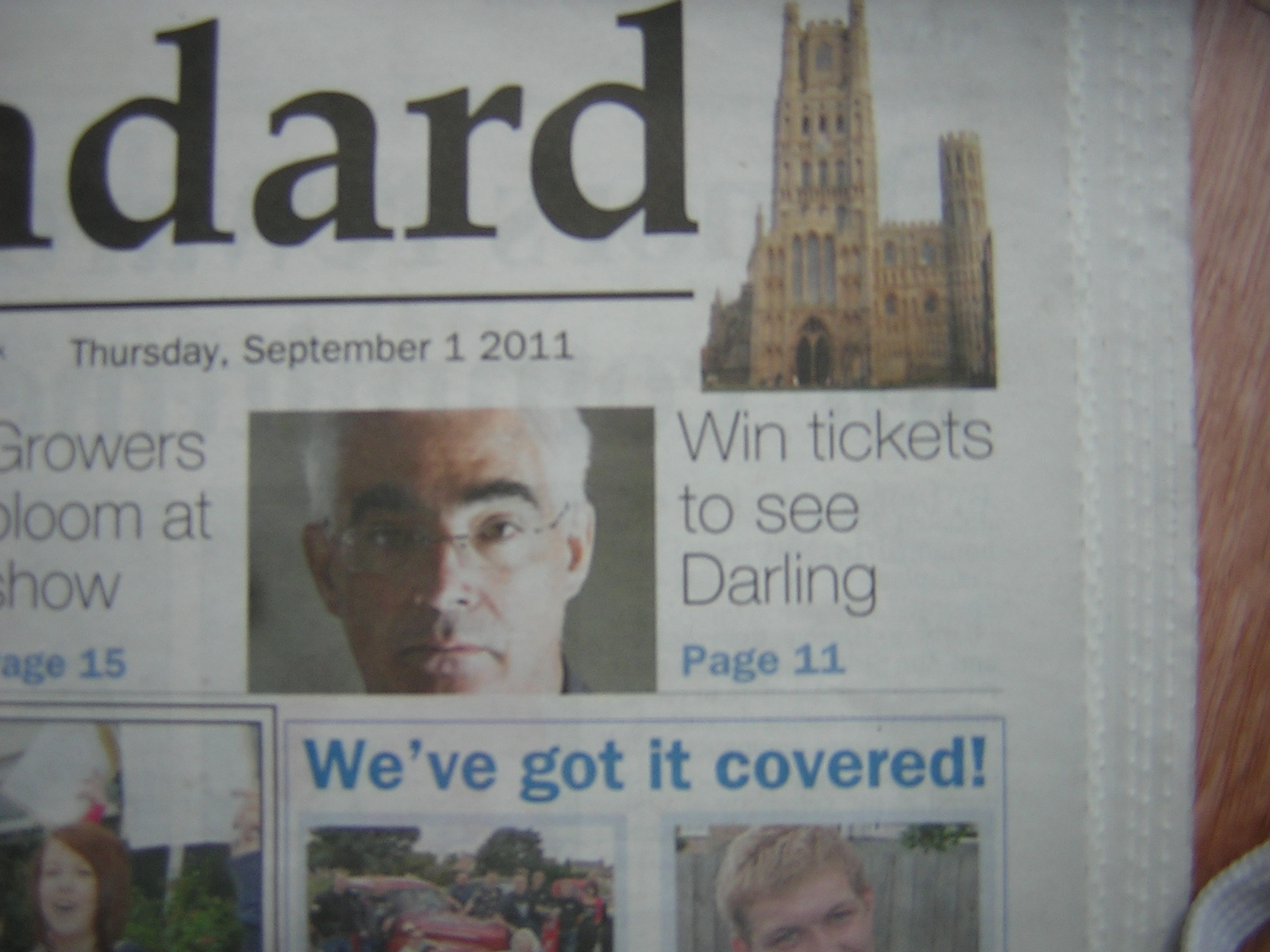
Alistair Darling has his book out: One Thousand and One Nights, the steamy tales told by an intelligent but unlucky courtesan who found herself married to an irascible knife-throwing sultan in the days of the Scottish Raj.

It features the laugh-a-minute bawdy escapade "It Started in America" and the x-rated erotic thriller "The Thief, The Prime Minister, His Lover and Their Banker".

Despite flirting with literary agent Eddie Bell at Bell Lomax Moreton the entrancing minx with intense eye-brows over-came his reluctance to kiss'n'tell, and signed to Maggie McKernan at her own outfit, the McKernan Agency, who acted with Capel & Land to take the book to publisher Atlantic (Toby Mundy).

The book was originally going to be called "My old job and how I expect to get paid twice" but McKernan is thought to have suggested that something sexier would go better in the run-up-to-Christmas market. Possibly something with cats on the cover, such as a white Persian being stroked by a podgy male hand.

Do not miss Alistair performing live the Dance of the Seven Veils, various venues all round the country. You would not belieeeve the tattoos.

Monday, 2 August 2010

Divorce, Beheaded, Died, Divorced, Beheaded


The court of Henry VIII continues to fascinate because this was the crucible of England, where the king changed the country more than even he realized.

The era is irresistible to historical novelists, probably to the irritation of historians, because the cast of characters widens as research uncovers minor characters and hence novel viewpoints to tell the story from.

Suzannah Dunn in "The Confession of Katherine Howard" returns to this period of which the reading public never tire. This time she writes from the point of view of a character who was listed in the papers as one of Katherine's ladies in waiting, Catherine (Kath.) Tylney.

She is writing in a genre where the giant talents of Hilary Mantel (Wolf Hall), the audacious Philippa Gregory (The Other Boleyn Girl) , the late "Jean Plaidy" (Eleanor Hibbert, who wrote everything else too) have set a very high bar.

Hibbert, although not a trained historian, was exact enough that her interpretations shine through many modern dramatizations. Recent adaptations have done little more than rip off the Jean Plaidy cover and lightly re-package the characters. Mantel is notoriously detailed in her research. She is on record as taking a dusty view of authors who cheat with the facts by concatenating events or putting impossible people together. In her view, the writer works with the obligation that what they imagine has to fit the historical facts.

Historical fiction - that is the sort which makes a novel out of agreed history - works like popular reconstructions. The facts are there as scaffolds, then the imagineers use what other information they can glean to work out how someone looked, how they might have thought, what their behaviour might have been. It's guess-work, but it should be informed guess-work. By convention, the novelists are allowed to import fictional characters to tell the story from their viewpoint and perhaps to thread in an alternative plot-line but even the fictional character must be plausible and researched. Also by convention, the authors warn the audience which are the fictional characters and where they are taking liberties. Dunn advises that the relationship between Cat Tylney and Francis Dereham has no supporting evidence; it's a plot device to give her a place to write from.

Suzannah Dunn finds something new in Henry's fifth wife, Katherine Howard. The standard view is of a very sweet but silly girl, ultimately a victim of other people's machinations. Dunn wonders if this can be whole story; Katherine was a Howard girl and therefore deeply political, even when cloistered in Horsham completing what passed for her education, but there was enough about her to attract a king, to make him think she was a pure country lass who somehow had arrived in his debauched court with her own maidenhead intact.

On the other hand, she wasn't so political that she understood that having married a king, she could not allow a breath of scandal any where near her. Expecting a young woman somewhere around eighteen years old to take on board the lessons of the four - count 'em, four - queens ahead of her is still expecting a lot, no matter how well-bred she is. We know this from our own age.

Merely having Katherine's old flame Francis Dereham near her was enough to set tongues wagging with gossip. Henry wanted to believe he had found what he was looking for, the rose without a thorn. Had Dereham stayed away from court the aging man would have discounted any gossip as malicious jealousy aimed at spoiling his own happiness. Katherine's close friendship with Thomas Culpepper, complete with a love letter, though, was asking for trouble. It would still cause an argument today if it turned up on the Jeremy Kyle show.

There are several telling points made in the book which illuminate the history. For example, the standard view is that the secret pre-contract of marriage to Dereham, which would have been a lawful impediment to her marriage to Henry, was what amounted to treason. Well, yes, up to a particular point. It wasn't treason at the point where Henry married Katherine, nor was the fact that she had had sex with Dereham, whether by choice or force. Henry changed the law afterwards, in 1441, to retrospectively make it treason to conceal the sexual history of a monarch's consort for more than 20 days after the wedding. (See also Imaginary Betrayals, Kate Cunningham p. 9)

Dunn points out what Archbishop Cranmer (in charge of the investigation) must have known: if had been accepted that Katherine had secretly pre-contracted marriage with Francis Dereham, then the short marriage to the King could have been swiftly annulled and the whole thing passed off as if it never happened. Henry getting an annulment was not altogether a new thing.

This would have been the kindest thing all round. It would have saved Henry's face and crucially, it would have precluded the separate question of whether the Queen had commit adultery - and therefore treason - with anyone else. This would have kept her head on her shoulders, even if she was packed off to a nunnery or forced to marry Dereham and live in a shed. Henry might never have changed the law on treason to be rid of her. Henry had a great deal of practice at changing the law to suit himself.

Katherine never understood the argument, if it was put to her. Her recorded answers to the enquiry was that Dereham forced her, that there was no pre-contract.

Instead, Henry was put in the position of possibly wearing the cuckold's horns - again - and this time he was an old and ailing man who could not regard himself as a victim of witchcraft. Under interrogation, Francis Dereham named Thomas Culpepper, one of Henry's own favoured associates, as the Queen's lover. It was only too painfully apparent that there's no fool like an old fool. If they had saved Henry's face, they might have saved her neck.

Something close to a face-saving effort may have been launched, but it hasn't been noticed by the wider public and I doubt it was at the time. Dunn carefully notes it in her briefing to readers. Francis Dereham admitted to having a sexual relationship with the Queen before her marriage, but not adultery. Thomas Culpepper never admitted adultery.

Their eventual conviction, despite an ambiguously-worded letter from Katherine and the possibly malicious testimony of other ladies, and Dereham's own accusation of Culpepper, was on a charge of presumptive treason, i.e. that they intended to have illicit relations with the Queen and thereby committed treason against the King's person. Since the inquisitors had torture available to them, they ought have been able to get the youths to admit to shooting the arrow at King Harold. What they confessed to, I would argue, was precisely what they were required to confess to and no more, thank you very much.

Katherine herself was never put on trial. Whatever she confessed to for the purposes of the investigators showing they had done a thorough job, the prosecutors were less keen to have her admitting it where a clerk would write it down and file it in the court papers. Henry could, if he chose, view it as the disgraceful behaviour of a manipulative young woman and not adultery. In essence, that's what he did, only that still left the problem of him being married.

With adultery not acceptable to Henry as grounds for divorce and Katherine refusing to admit pre-contract, there was only one other method for ending a marriage. Henry made it clear in a speech on February 6 that she was certainly guilty of failing to disclose her sexual past, and that was to be defined as treason when the deception was practiced against a King "esteeming her pure cleane maide". Everyone was now clear what Henry had decided and would not be accused later of acting precipitately.

Four days later, on Friday, 10 February 1542, Katherine was taken from Syon House to the Tower, and on Monday 13 February, at around 7am, the girl who was about 20 - her age is disputed, she could have been as young as 17 - was executed.

Dunn therefore has to grapple with the difficulty that her main characters are all young females who don't get out much. She has to describe a convoluted political age from the point of view of a handful of pampered, ill-educated, poorly-informed idiots. The author faces this challenge and delivers an insight:

"To see us there, no one would ever have guessed that we were barely free of a decade of deconstruction: the stripping of the churches and dismantling of monasteries, the chaining of monks to walls to die, the smash of a sword-blade into a queen's bared neck. None of it had actually happened to us, though; it'd passed us by as we'd sat embroidering alongside our housekeeper. Our parish church had been whitewashed, the local priory sold to a rich man, and we'd celebrated fewer saints' days, but that, for us, had been the extent of it. "

That has the ring of truth about it. There had been dissent, even the Pilgrimage of Grace, but for most people the underlying shift of power might not be apparent. After all, Henry insisted he was a Catholic, but just one who had supplanted the authority of the Pope - not of God. A young queen, little more than a child, would simply not appreciate how profound was Henry's, and the country's, need for peace and reassurance at that moment.

The state documents from the trial of Dereham and Culpepper are in the National Archives. A search on her name returns, amongst other things, these catalogue entries

"Letters and Papers ... of Henry VIII, vol. XVI: 1541 Aug 22-Nov 18.
The undated letter from Katherine Howard to Thomas Culpeper (LP, XVI, no 1134: SP 1/167 p 14) was placed in this volume at the end of August, although the editors later considered that it should have been placed in early August"

"The Kings Bench records
special oyer and terminer roll and file Principal Defendants and Charges: Lord William Howard and others, concealment of the criminal conduct of Queen Katherine Howard."

The giant 246 volume compendium of Henry's state papers are described thus:

"The collection is particularly full in the late 1520s and 1530s with the marriages of Henry VIII with Katherine of Aragon, Anne Boleyn, Jane Seymour, Anne of Cleves, Katherine Howard and Katherine Parr, and the break with Rome, the dissolution of the monasteries, and the Pilgrimage of Grace."

The entry explains, with what sounds like an ancient sniff of reproach, that Sir Thomas More destroyed his papers, so it has to make do with the archives of only Cardinal Wolsey and Thomas Cromwell. As an after-thought it adds:

"It also covers wars and alliances with the rest of Europe".

If you enjoy historical fiction Dunn delivers a top-quality re-working of an episode. The writing is fast and smooth and does not sentimentalize the characters merely because they were teenagers. As Katherine's marriage to Henry lasted under two years, the story is a shorter than the giant arc which Mantel is attempting, making it more suitable for a couple of days on the beach - except if you insist on a happy ending in holiday fiction.

The Confession of Katherine Howard
by Suzannah Dunn
Harper Press 2010
£12.99

Quiz Time:
Which wife of Henry the Eighth are you?