David Cameron and other MPs think they can negotiate with European law. It is a very old delusion caused by not being bothered to buy even an entry-level primer.
During the 1980s Mrs Thatcher threw millions of pounds down a series of drains called Factortame. The essence of this festering sequence of cases was that the British government thought it could protect our fishing rights by specifying who could own British-registered ships based on nationality, even though the British government had signed those rights away in a treaty.
You do not need to be a lawyer to understand that if you have signed a reciprocal treaty and then you go to the trade court moaning that 'snot fair, they will just point to your signature on the bottom of the deal. What are you complaining about? You want to fish their waters, they want to fish yours. You can own their boats, they can own yours. If you can't take a joke, you should not have signed up.
The code word for this is 'pooling our sovereignty in designated areas'. i.e. All of them. Whereas I think sovereignty is like virginity. You either are, or you aren't.
European law takes precedence over English law. Politicians should check what the European Court of Justice said half a century ago; they need not take this blog's word for it - why not ask a reputable law publisher?
Thompson Reuters is offering a key freebie. You can have a section of the Nutshell Guide to European Law online. For political purposes you do not even need to read all of it. Just scroll down to their section 4, EU and National Law, page 36,37, 38.
People feeling studious can read to the end, though. It is not long - only ten pages of core material as the rest is surrounding items such as the cover. Somebody should print this out for the Prime Minister.
Showing posts with label Law. Show all posts
Showing posts with label Law. Show all posts
Monday, 2 June 2014

Saturday, 14 December 2013
Stephen Hester, Shake me up, Judy
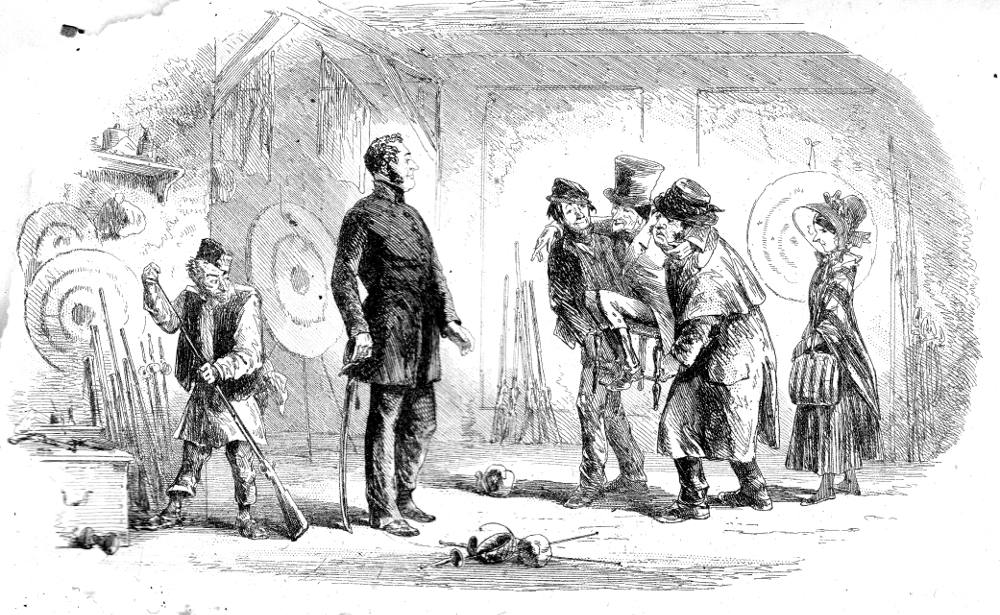 |
| "I have come down" repeats Grandfather Smallweed , hooking the air towards him with all his ten fingers at once to once, "to look after the property".(*) |
Scan credit: George P. Landow at Victorian Web
Stephen Hester will step down from the leadership of RBS this month with a payoff thought to be in the region of £1.6m, according to Wiki, nearer to £6m if you include share options (according the The Mirror). He earned around £1.2m a year, making £6m over his term in the seat, and took an additional £6.5m in bonuses and pension payments in 2010, after which people started to put pressure on the new government to DO something.
Only, since Stephen Hester was a Conservative donor, they didn't try very hard and as for the Lib Dems, Vince Cable decided to ignore the occasional story he heard, adopting his standard position of hazy old duffer who cannot be expected to remember anything or grasp the significance of it if he does.
At the time of the previous story which featured Hester, it was felt that I had been rather hard on a man who was not in direct control of the insurance group and anyway, was turning round a failed bank. Furthermore a man who knew the difference between right and wrong and had said so in a video interview to the Telegraph. (May be behind a paywall, depending on your usage)
"It is an extreme example of a selfish and self-serving culture which the whole banking industry is tagged with," he said, adding that it was the board's job to ensure that sort to behaviour has no "validity in the future".It recently emerged that RBS used another special group of which Hester will no doubt claim to have come over all Vince Cable about, the Global Restructuring Group, GRG, with thanks to Felix Salmon at Reuters who has presented the story clearly. RBS foreclosed loans because it could get more immediate value out of stripping the assets the debtors had put their lives in to. Using the GRG group, it engineered defaults to give itself permission to help itself to the fruits of other people's labour, selling them a knock-down prices to its own subsidiary, West Register.
Perhaps unusually in this day and age, the story seems to have bubbled under with the debtors being unable to form a coherent pressure group. Possibly that is because it is very difficult to distinguish, from the outside, a good business being pushed under by the bank and a bad business which should be stopped before it gets any worse. When stories started emerging in July 2013, RBS and Hester coolly said they could not comment on individual cases, implying that debtors must all be unreliable complainants - and no doubt some of them are. The Tomlinson Report draws together the method the bank used. Lawrence Tomlinson also credits an investigation by the Sunday Times and the work of Sir Andrew Large.
Many in the banking trade have counted on this story being too convoluted to grasp . They have forgotten that Mr Dickens already explained it in 1853. This year was the 160th anniversary of the conclusion of Bleak House.
In the illustration above, the old payday lender Smallweed has extended rolling credit to Captain George who has used it to buy a shooting gallery. This barely makes enough to keep him and an assistant in tea and bread but earns just enough to keep paying Smallweed his interest. Probably it is a bad business but George is making his payments and trade might improve.
It then transpires George has an asset he was not aware of; he holds a letter from a late friend which can be used as a sample of handwriting to positively identify the writer of other documents and letters. Smallweed knows to whom that sample has value and he wants to be rewarded for brokering the deal. The only trouble is, George takes advice and is certain that he does not want to be involved.
Smallweed then brings pressure on him because the loan is not secured just against George's own person but the property of his friend Mr Bagnet. Smallweed demands full repayment, knowing full well that George has no way to do it and must therefore surrender the letter for inspection. Which he does.
If people are capable of following the plot of Bleak House and how Smallweed manipulates George to get what he wants, they are capable of understanding what RBS was doing. Shake me up, Judy.
........................
(*) Yes, I know Smallweed says this when he goes to Krook's house rather than George's shooting gallery, but the sentiment fits best.
Friday, 6 December 2013
Social Workers have too much free time
....the chief executive of the British Association of Social Workers Bridget Robb says the report on social work in the UK offers an insight into how stressed, overloaded and under-resourced social workers have become.Source ITV News
This week Essex social workers, a health trust and members of the judiciary have found themselves side-tracked by having to deal with the outrage over their handling of an unwell Italian woman.
The bare bones as everyone knows are that a visiting Italian woman had an episode associated with a condition of being bi-polar. The police took her to a mental hospital which sectioned her although she explained she was a foreign national and said she wanted to go home. Bi-polar people are irrational when they are distressed, but then so are some people who are not bi-polar. This is not the same as lacking the capacity to give consent, the capacity may fluctuate. Besides, going home seems pretty rational to me. Best place for her.
She was pregnant but that makes no difference in this instance. What matters is that a foreign national who had committed no crime was detained against her will. The only thing the Health Trust should ever have done was stabilize her and put her on a plane home, with an escort if necessary, after liaising with the Italian authorities. Their citizen, their problem. She was not exercising her EU rights to remain in Britain.
Instead, for reasons which have yet to be disclosed, the hospital 'looked after' her for the next ten weeks from 13 June 2012 to 23 August 2012 . Ten weeks is ample time to arrange a short plane ride. Her right of free movement, also established in EU law, was interfered with. She had a right to be ill where it suited her, not the Health Trust. She now says that she was shocked and had no inkling that she would be forced in to surgery. No, but somebody knew because the Health Trust did nothing until she was ripe (39 weeks), then they applied for emergency powers, giving the judge (Mostyn M-J) the bum's rush late one afternoon. Mostyn agreed to let them act without seeking her consent on the pretext that she lacked capacity to consent and that it was in her best interests. That is, he took at veterinary approach . He did not check thoroughly for capacity or lack thereof.
The Trust is going to have to explain why it chose to do that and how it colluded with Essex cc social workers to give the judge no time to make an order returning her to Italy.
We have many British citizens and traumatised refugees who may need ten weeks adult in-patient care. Towards them we have a humanitarian duty. Instead we have spent hundreds of thousands of pounds on in-patient care, lawyers, social workers and court time to hold someone who could, and should have been treated in their own country.
Our humanitarian duty to this lady was to escort her home safely as quickly as possible, which is where she wanted to go. You do not need a degree in law or social work to see this. Nor do you need to be a whackjob conspiraloon to ask "Why were they holding on to a foreign national whom they were anxious to get rid of after the birth?"
Surely it is obvious that if you say you are snowed under with child protection work, what you do is send home those who want to go and who can be cared for by their own social service departments,. Essex CC knew that the baby is half-Italian, half-Senegalese and that her mother, father, siblings and grandparents - the whole extended family - are in Italy. It may be she will be adopted, but it is in her interests to be adopted in Italy because that is where her real family is. It is where she is from.
The judges, being separate, do not notice they are being hustled. Although Mostyn M-J agreed to hear the interim care application himself, the social workers obtained a different judge, Parnell, to hear it. That way they controlled what Parnell was told. Classic control dynamic; limit the extent to which the marks can compare notes. Later, Judge Newton recorded that he did not understand the background which had been obscured from him. He did not ask himself 'why is this obscure?'.
Call me what instrument you will, though you can fret me, yet you cannot play upon me is what the judges should have said. Only they could be, and were.
Their final step will be to get Judge Munby to reluctantly agree that since the child has been attached to the foster carers for so long and speech will now be well-advanced at 15 months, the social workers will be allowed to continue as per the adoption order. He will find it very hard to resist this argument.
I call bullshit. Social workers have got too much free time and they've been using it to do baby-selling, using our dollar to fund the farming operation. Plus, they've now made sure that any pregnant or post-natal woman feeling a bit dicky will not call her doctor in case they end up snatching the kid, so we can look forward to an increase in suicides. The correct name for this is 'anti-social work'.
If the social workers don't like that conclusion, perhaps they should behave differently.
Silver lining though - it is now published right round the globe that if you come to Britain they'll knock you on the head and nick your baby and tell you it's legal. The BNP itself could not have come up with a finer deterrent to immigration.
Monday, 2 December 2013
TOWIE
 |
| A load of stinking offal |
A foreign woman who was raped whilst in hospital is being told that she cannot take action because the rapist claims that he was legally obliged to fuck her and that it is alright as she's a nutter and anyway, they took the precaution of knocking her out first.
The woman was in Britain for a two week training course and became temporarily confused by the parking system at Stanstead Airport. She called the traffic police who concluded she was a hysterical Latino type and that she should go to hospital to calm her down.
The woman was detained by the hospital - which turned out to be psychiatric unit - because there were hardly any other crazy people from Essex to deal with. The woman wanted to go home, but as she apparently lived in an uncivilized place called Italy, the hospital continued to define her as an utter nutter and hung on to her claiming that it was all for her own good. You cannot trust these foreign types, Mafioso and so forth.
After about five weeks it became apparent that all she really needed was a good seeing-too, probably a lesbian, but it needed to be all legal. Normally no one in a theraputic relationship with a patient is allowed to have sex with them, so a court order would be necessary.
Essex Social Services and the lawyers appointed to 'see to' the woman went to the Court of Protection where they got Mr Justice Mothballs (adulterer and known as 'Mr Payout' when he was divorce lawyering) to agree that it was definitely in her interest to have a good porking, sort her out no end, women, who'd have them, by the way, did I tell you my wife of 30 years, the cow, is trying to insist I have to pay her money if I want to trade her in for a younger model...not that I have any problem with women, do I ladies?
Mr Justice Mothballs signed the order and further agreed that she should be shoved on a plane as soon as possible thereafter since that was what she had been requesting for the previous month, but she couldn't possibly be allowed to go without being shown the error of her ways.
There was a slight difficulty in finding a normal heterosexual doctor who actually wanted to fuck an unconscious and thereby unconsenting woman, regarding that as unethical and disgusting no matter what the stupid paper said, but eventually a psychopathic doctor was found who was running for a job at Stafford Hospital. He found the erotic possibilities of the court order and an entire theatre team watching him stick it up her, legally, without consent, an amazing aid to performance. Apparently the videos are to be put on Youtube.
The woman woke up back in Italy, walking funny and finding a knife-wound to her belly, suggesting that the doctor had fucked her in an unusual manner, more like something out of Stephen King. She wondered if she had been impregnated and was going to give birth to the devil but it turned out that precisely the opposite had happened and the doctor had collected tissue at the request of Essex Social Services. Social workers claimed she is much better now that she had experienced a Real Man but, perhaps surprisingly, she claims she does not. Told you, prob'ly a lezzer, the ungrateful bitch.
The woman is currently undergoing explorations to see if her ovaries are still there or
This was confirmed by Judge Noballs at Chelmsford Crown Court, where the woman brought a suit against her treatment. The judge said that the woman certainly sounded sane now, but she might go all funny and foreign at any moment and anyway, she could not possibly be interested in the whereabouts of a five-pound tumour which was now being used in research or broken for spares or something.
An interesting question from this is how was the tissue recorded? Normally tumours of this size have to be formally recorded and in particular the name of the host must be on it, but due to the court order and the rape, this tumour was less traceable than even a calf born in a dairy herd. Intriguing.
Essex Social Services have reminded people that they are very keen to protect any young women who think they might be feeling a bit panicky. You are invited to ring them to report any you may know of, particular if the young lady is fit and of child-bearing age.
.....
Bloggeratti
Ambush Predator
Autonomous Mind
Counting Cats
Longrider
Tim Worstall
Quiet Man
Birthrights - legal briefing by Elizabeth Prochaska
John Hemming MP. Careful visiting the UK whilst pregnant.
John Hemming MP. Bipolar UK issue statement in support of mother
John Hemming MP Italian Mother: Statement 1
John Hemming MP Italian Mother : Statement 2
Update: according to John Hemming the case has been transferred from Chelmsford to the High Court where it will be heard by the President of the Family Division, Sir James Munby. Sir James gave a recent address on the reforms he hopes to see.
Mr Justice Mothballs has previously made his opinion of Sir James Munby clear by naming seven pet pigs after him. Fat lot of good it is being educated at Amplesides, complaining about the secularists and describing oneself as a Catholic if you are going to sign orders to slice up a woman to get to her baby - and probably an Italian Catholic woman - in secret.
ITV Coverage
Essex County Council timeline
(Sorry, above link mysteriously 404, will restore data on new link).
Court of Protection - orders
Adoption Ruling of February 2013
Saturday, 10 August 2013
Colover Crisis
Sometimes, just one word chosen tells you all you really need to know. In this case that word was 'predatory' .
Neil Wilson, 41, had admitted sexual activity with a child of 13. The trial had been held, he had pleaded guilty and was entitled to consideration at sentencing for his cooperation with the authorities and his recognition that he had been entirely in the wrong to groom the child in order to encourage her to perform a sex-act on him. He had moved from Romford, the place of the offence, to York, suggesting that he had wisely moved away from the victim.
At the sentencing hearing all these facts were already agreed, the defence had already had all the disclosure it required, and the defender, Rebecca Blain - a solicitor advocate - was able to make her case that her client was very low risk and could therefore be considered for a non-custodial sentence.
That was for the judge, his Honour Judge Peters QC sitting at Snaresbrook Crown Court to consider.
The prosecutor, Robert Colover, an experienced barrister was appearing for the CPS. His job at the sentencing hearing at Crown Court is specified within the CPS document:
Instead of representing the public interest Colover suddenly took it in his head to try to act for Wilson, who was not his client, and decided on a strategy of blaming the victim, rubbishing her character, saying it did not much matter as she was already damaged goods, and that in any case the hot little minx was gaggin' for it.
Note please that the appointed defender did not consider that was what she wanted to say on behalf of her client. Rebecca Blain did not think it necessary to discuss the victim. If she had done so, she would have had to give notice of that as the protocol for this is also available from the A-G's office
At this point Honour Judge Peters QC failed to spot that Colover had strayed disastrously from his brief. Instead of politely ignoring the irrelevant remarks from the prosecution and concentrating on what the defender wanted to put forward for consideration, Judge Peters decided to take Colovin's remarks on board as if he was acting for the defence and repeated:
Rebecca Blain is listed as a partner at DPP Law and appears on the duty solicitor rotas. The practice in which she is a partner gives no profile, possibly as a protective measure although she has done nothing other than her job properly in accordance with the A-G guidelines.
Summary
Robert Colover, representing the public interest, forgot who he was acting for and indulged in victim-blaming which, if the defence had tried it, would have been his duty to challenge as per the A-G's advice. Possibly he was unwell or became hopelessly confused as he more commonly works for the defence.
Rebecca Blain, defending, did her job properly. Due to irrelevant remarks made by Colover and the Judge, her client is now facing more uncertainty rather than having the case settled as the sentence may be reviewed.
His Honour Judge Peters QC, despite being a QC, became confused as to who was making the plea in mitigation, possibly because it was a lady solicitor.-advocate. Since the contentious and irrelevant comments came from a hitherto respected barrister who more commonly appears for the defence, the judge threw the legal advice out of the window and joined in with the victim-blaming. His is the worst failing because he is supposed to be running that hearing.
The victim has been blamed by a prosecutor and a judge, which will do wonders for encouraging other victims to come forward.
Perhaps it is not only fear of being called raaaaycists which has made the CPS tardy in applying the Sexual Offences Act 2003 to deal with grooming gangs. It appears they have been fighting uphill against a judiciary which regards preying on children for sex as as not really a proper crime at all.
Neil Wilson, 41, had admitted sexual activity with a child of 13. The trial had been held, he had pleaded guilty and was entitled to consideration at sentencing for his cooperation with the authorities and his recognition that he had been entirely in the wrong to groom the child in order to encourage her to perform a sex-act on him. He had moved from Romford, the place of the offence, to York, suggesting that he had wisely moved away from the victim.
At the sentencing hearing all these facts were already agreed, the defence had already had all the disclosure it required, and the defender, Rebecca Blain - a solicitor advocate - was able to make her case that her client was very low risk and could therefore be considered for a non-custodial sentence.
That was for the judge, his Honour Judge Peters QC sitting at Snaresbrook Crown Court to consider.
Summary So FarThen things went weird.
- This was a sentencing hearing.
- There was no dispute about the facts, there was a guilty plea which had been accepted.
- The convicted person had a representative who was the proper person to make decisions about what should be put before the judge from her client's point of view. The defender already had all the disclosure they needed to enable her to do that job.
The prosecutor, Robert Colover, an experienced barrister was appearing for the CPS. His job at the sentencing hearing at Crown Court is specified within the CPS document:
The Role of the Prosecutor at Sentencing
The prosecution advocate represents the public interest, and should be ready to assist the court to reach its decision as to the appropriate sentence. This will include drawing the court's attention to:
- any victim personal statement or other information available to the prosecution advocate as to the impact of the offence on the victim;
Instead of representing the public interest Colover suddenly took it in his head to try to act for Wilson, who was not his client, and decided on a strategy of blaming the victim, rubbishing her character, saying it did not much matter as she was already damaged goods, and that in any case the hot little minx was gaggin' for it.
“The girl is predatory in all her actions and she is sexually experienced.This is not a victim's personal statement. It is victim-blaming.
“She appeared to look around 14 or 15 and had the mental age of a 14 or 15 year old despite being younger than that.
“There was sexual activity but it was not of Mr Wilson’s doing, you might say it was forced upon him despite being older and stronger than her.”
Note please that the appointed defender did not consider that was what she wanted to say on behalf of her client. Rebecca Blain did not think it necessary to discuss the victim. If she had done so, she would have had to give notice of that as the protocol for this is also available from the A-G's office
Pleas in MitigationSo not only did Colover try to act for the wrong person, he did so by playing an antique 'blame the victim' card in defiance of the properly appointed defender and the A-G's advice.
The prosecution advocate must challenge any assertion by the defence in mitigation which is derogatory to a person’s character, (for instance, because it suggests that his or her conduct is or has been criminal, immoral or improper) and which is either false or irrelevant to proper sentencing considerations.
At this point Honour Judge Peters QC failed to spot that Colover had strayed disastrously from his brief. Instead of politely ignoring the irrelevant remarks from the prosecution and concentrating on what the defender wanted to put forward for consideration, Judge Peters decided to take Colovin's remarks on board as if he was acting for the defence and repeated:
On these facts, the girl was predatory and was egging you on.The only explanation I can think of for this is that since Colover is well-known and deeply respected, the judge simply accepted what he said instead of recognizing it for the aberration it was. However, another explanation might be that Judge Peters failed to recognize that the female solicitor as the relevant defender, what with her bein' a girlie and moreover one 'o them new-fangled solicitor advocates.
Rebecca Blain is listed as a partner at DPP Law and appears on the duty solicitor rotas. The practice in which she is a partner gives no profile, possibly as a protective measure although she has done nothing other than her job properly in accordance with the A-G guidelines.
Summary
Robert Colover, representing the public interest, forgot who he was acting for and indulged in victim-blaming which, if the defence had tried it, would have been his duty to challenge as per the A-G's advice. Possibly he was unwell or became hopelessly confused as he more commonly works for the defence.
Rebecca Blain, defending, did her job properly. Due to irrelevant remarks made by Colover and the Judge, her client is now facing more uncertainty rather than having the case settled as the sentence may be reviewed.
His Honour Judge Peters QC, despite being a QC, became confused as to who was making the plea in mitigation, possibly because it was a lady solicitor.-advocate. Since the contentious and irrelevant comments came from a hitherto respected barrister who more commonly appears for the defence, the judge threw the legal advice out of the window and joined in with the victim-blaming. His is the worst failing because he is supposed to be running that hearing.
The victim has been blamed by a prosecutor and a judge, which will do wonders for encouraging other victims to come forward.
Perhaps it is not only fear of being called raaaaycists which has made the CPS tardy in applying the Sexual Offences Act 2003 to deal with grooming gangs. It appears they have been fighting uphill against a judiciary which regards preying on children for sex as as not really a proper crime at all.
Thursday, 27 June 2013
Careers Advice for Under-cover Operators
 |
| PC Huggable |
prosecutors would decide whether operatives who had sexual relationships were breaking the law.
(source: Daily Mail Tuesday, Jun 25 2013)Back to the police. I'm going to assume most of the personnel involved are men although there might well have been female under-cover(s) operators. It is alleged that some of them engaged in sexual intimacy under false identities and for purposes other than those they claimed at the time.
The gender misrepresentation cases put down one marker for what will be regarded as making consent defective because it has been obtained falsely. Another is already unambiguously covered in legislation. If the complainant had a mental disorder impairing choice such that they can be brought within the definition of s.34 of the Sexual Offences Act 2003, then the person who deceived them can be prosecuted.
A further restriction was defined in 2007 when Giovanni Mola was unable to argue he had consent in order to avoid a conviction based on reckless conduct (Scottish case). He failed to inform a lover that he had HIV, thus impairing her ability to make an informed decision whether to have sex with him. A summary of other cases is here
Prosecution of cases around transmission of HIV have abated as a matter of public policy; the emphasis has gone on to prevention as it was feared that the prosecutions were deterring people from seeking treatment. The policy remains controversial. Opinion is split on whether agreeing to sex means agreeing to factors unknown, or whether it is a conditional consent depending on what is disclosed at the time.
Consenting to sex does not mean consenting to everything even in the ordinary course of events. There is a point at which an act may become abusive and outside the scope of consent. Normally this is thought of in physical terms but it could be psychological. But for ignorance that the person was married/had a disease/was a paid infiltrator, the complainant might not have agreed to sexual intimacy.
It is argued that deception is justified in order to infiltrate organisations "such as environmental groups". Fat lot of good that did. Mark Kennedy should have been putting it about in the Climate Unit of UEA, or at least offering Chris Huhne a ride. He has failed to prevent the country being peppered with taxpayer-subsidised bird-mincers.
As David Morris of the McLibel trial said when it emerged the co-writer of the leaflet which caused all the trouble was Bob Lambert, an undercover policeman,
"All over the world police and secret agents infiltrate opposition movements in order to protect the rich and powerful...."Look how well that went. McDonald's ended up paying lawyers millions of pounds, only half-winning a technical case and smashing their reputation. Whether they asked for the Metropolitan police to act as political agent provocateurs has yet to be examined.
Wednesday, 22 May 2013
The Death Penalty
There is a parallel between the 1965 vote on the abolition of the death penalty and the 2013 vote on same sex marriage.
The vote on same-sex marriage went 366 in favour to 161 against. That is, approximately two thirds of the House supported the government. The larger part of the one-third opposition was not the Opposition at all; it was the government's own party. In a free vote, the government only got its bill through by doing deals with the party which it nominally opposes.
Despite the parliamentary feeling that the argument about the death penalty is done and dusted, no politician would dare put the matter before the public. The public is much less convinced that there is any point in keeping Ian Huntley breathing, and it is about to ask the same question of David McGreavy who has failed in his bid for anonymity. Despite what some people claim, the law does not lead public opinion as much as they would like, nor is it clear that we get good law when it tries to do so.
English law jumps before it is pushed in order to disguise that hand of the pusher.
The vote on same-sex marriage went 366 in favour to 161 against. That is, approximately two thirds of the House supported the government. The larger part of the one-third opposition was not the Opposition at all; it was the government's own party. In a free vote, the government only got its bill through by doing deals with the party which it nominally opposes.
In 1965 the Labour MP Sydney Silverman, who had committed himself to the cause of abolition for more than 20 years, introduced a private member's bill to suspend the death penalty, which was passed on a free vote in the House of Commons by 200 votes to 98. The bill was subsequently passed by the House of Lords by 204 votes to 104.Source: wiki, which goes on to detail the exclusions and parliamentary technique used to present abolition as suspension. The split, again, was a two-thirds for change, one-third for the status quo. Note also in subsequent developments that there was a deadline; the abolition had to be enacted in English law before a European-set deadline. If it had not been done then the authority of European law would have become much more visible to the voting public. As with same sex marriage, the impetus is not from within Britain but to disguise the fact that the real power comes from outside it.
Despite the parliamentary feeling that the argument about the death penalty is done and dusted, no politician would dare put the matter before the public. The public is much less convinced that there is any point in keeping Ian Huntley breathing, and it is about to ask the same question of David McGreavy who has failed in his bid for anonymity. Despite what some people claim, the law does not lead public opinion as much as they would like, nor is it clear that we get good law when it tries to do so.
English law jumps before it is pushed in order to disguise that hand of the pusher.
Friday, 12 April 2013
Prosecutions for use of Social Media
There seems to be a lot of activity around the subject of investigation and prosecution for the use of the social media. I think the document people may be looking for is this:
If your query concerns Paris Brown, who recently stepped down from being a Youth Commissioner for Kent Police, the following CPS clarification may be of interest to you:
The Scotsman has some figures which may also be of interest:
.....
Update 1 May 2013
Olswang LLP, who represented Paris Brown, have provided an excellent summary of the case.
Essentially, the police had to respond to the 50 complaints about a few tweets although they've got plenty of burglaries, murders and rapes to be going on with.
Responding suitably should have taken about a morning to check the published guidelines and note that the material arguably didn't come with in the scope of the guidelines, it had been removed, an apology had been given, and Paris Brown was under 18 so the bar for prosecution is set very high. They could have asked a CPS lawyer if they weren't sure what the guidelines meant. Then they could have politely declined to take the matter further.
Instead - and this is what we should be kicking about - they used the mere excuse of complaints of being offended to confiscate property and interview a child under caution. Then they had to drop any thought of charges since it was obviously a non-starter. Well done to Olswang for highlighting this abuse of process.
...
It is obviously ridiculous that a teenager has to call in a lawyer to protect her from the agents of the state who should have had more sense than to join in with child-kicking. Was their purpose in doing so nothing to do with the 50 complaints but rather a convenient excuse to examine communications between a police commissioner and her appointee?
Following the irregularities in the Andrew Mitchell Affair (which is still being investigated) there needs to be an independent investigation of the 50 source complaints to see if they were in fact genuine members of the public or if there was a concerted action by either a political lobby, police or those connected to them such as close family.
Issued by the Director of Public Prosecutions on 19 December 2012
If your query concerns Paris Brown, who recently stepped down from being a Youth Commissioner for Kent Police, the following CPS clarification may be of interest to you:
where a communication has been sent that is grossly offensive, indecent, obscene or false, there are a number of factors that are likely to mean that a prosecution is not in the public interest.
One of these factors is whether the suspect has taken swift action to remove the communication or expressed genuine remorse.Brown apologized and removed the items. It is difficult to see any public interest in taking the matter any further.
The Scotsman has some figures which may also be of interest:
Scotland Yard revealed that three police officers have been sacked for misusing social media over the past five years. Allegations linked to the use of sites including Facebook and Twitter have been recorded against 75 Metropolitan Police officers since 2009, with 38 of the claims substantiated.Disclaimer: this post is merely a link to relevant documents.
.....
Update 1 May 2013
Olswang LLP, who represented Paris Brown, have provided an excellent summary of the case.
Essentially, the police had to respond to the 50 complaints about a few tweets although they've got plenty of burglaries, murders and rapes to be going on with.
Responding suitably should have taken about a morning to check the published guidelines and note that the material arguably didn't come with in the scope of the guidelines, it had been removed, an apology had been given, and Paris Brown was under 18 so the bar for prosecution is set very high. They could have asked a CPS lawyer if they weren't sure what the guidelines meant. Then they could have politely declined to take the matter further.
Instead - and this is what we should be kicking about - they used the mere excuse of complaints of being offended to confiscate property and interview a child under caution. Then they had to drop any thought of charges since it was obviously a non-starter. Well done to Olswang for highlighting this abuse of process.
...
It is obviously ridiculous that a teenager has to call in a lawyer to protect her from the agents of the state who should have had more sense than to join in with child-kicking. Was their purpose in doing so nothing to do with the 50 complaints but rather a convenient excuse to examine communications between a police commissioner and her appointee?
Following the irregularities in the Andrew Mitchell Affair (which is still being investigated) there needs to be an independent investigation of the 50 source complaints to see if they were in fact genuine members of the public or if there was a concerted action by either a political lobby, police or those connected to them such as close family.
Monday, 8 April 2013
Job of the Month - Chief of Staff, Kent Police
Quick - here's your chance for 90k's worth of goodies plus pension contributions and all the rides in blues and twos you can handle. Luckily, you won't have to do anything nasty like real work or dealing with dangerous violent people - it's all pretendy work. No formal qualifications or experience required.
Ann Barnes hasn't a clue how to do the job despite being elected to be the new Commissioner. Her first puppet was an average teenager who was in tears within a week because Ann failed to recognize that actually, you are nuts to expect a child to carry that kind of responsibility and public exposure. Her second appointment is supposed to figure out how to do the job, and do it, so that Ann can continue to collect the dosh for pretending to.
Anyhoo, here's the outline:
By the by, you have to be nice to Paris Brown, the youth commissioner - but then for goodness sake, the child was always going to be made to look awful. Think of it as social work, trying to patch up Ann's idiocy.
Here's what Ann promised the people of Kent and what she is now relying on you to implement for her.
In a better world this job would not exist because the Chief Constable would already be doing most of it, but since it does, why not put in an on-line application and give that money the very best chance of a good home where it will be appreciated. The real police will regard you with all the enthusiasm of something nasty on their shoes, but as soon as they get the drift of where you are coming from - being Ann's walker - they will at least temper their derision with pity.
My tip for the job would be to make friends with the mounted divisions, then get the horses out on PR appearances in the shopping centres. Everyone loves police horses.
Alternatively, if this seem too much like hard work and you are male, consider getting two women pregnant with at least five children apiece, then live on benefits. I gather it pays about the same. On balance, I know which I'd prefer to subsidize.
Update 10/4/2013
The Mail reports that Paris Brown has stepped down following reports that the police have been dragged in on the basis that her tweets may be within the scope of the criminal law. Her previous job - a trainee booking clerk in the parks department - may not be open to her now that her employers have an excuse to sack her for her comments.
So now we've got an unemployed and possibly unemployable child under the age of 18 whose biggest sin, as far as we know, involves being a bit gobby. No arson, mugging, embezzlement, torture of animals, not even as much as a caution for dropping litter - just a kid mistaking their nascent musings for hip writing which, of course, never happened before in the history of text.
Ann Barnes is still there on £85k (which is surprisingly less than her lieutenant will earn) while having shoved a kid through this sugar-cane crusher in pursuit of her own public image. The moment the allegations emerged she should have taken protective action instead of making the teenager humiliate herself in public for Ann's programme.
The only person who owes it to the electorate to step down is Barnes for having shown such obvious lack of commonsense and duty of care in the first place. If Keith Vaz had any decency he'd resign too. Yes, I know, don't hold my breath.
Update 11/04/2013
The Times reports that the police have been criticized by media lawyer Mark Stephens, who pointed out that Keir Starmer already issued guidelines on investigation of comments on social media. What exactly it has to do with Starmer, who runs the CPS but not the police, I'm not quite sure, but it is his job to advise about offences so it is probably worth checking what he says. The point here is that twenty years ago a police officer would have understood that one is free to hold odious opinions and express them. Now, the expression of those opinions - not just incitements against target groups - is something the state feels free to investigate so long as it has the flimsy excuse of 'somebody complained'.
These are the interim guidelines
The comments attributed to Brown were likely to fail the 'high threshold' test i.e. there was no public interest justification in pursuing them. Or, put it another way, if Brown is going to be chased, then so should many of the commenters on the passing of Mrs Thatcher.
Ann Barnes hasn't a clue how to do the job despite being elected to be the new Commissioner. Her first puppet was an average teenager who was in tears within a week because Ann failed to recognize that actually, you are nuts to expect a child to carry that kind of responsibility and public exposure. Her second appointment is supposed to figure out how to do the job, and do it, so that Ann can continue to collect the dosh for pretending to.
Anyhoo, here's the outline:
This post will provide the mainstay of direct support to the Kent PCC. This is the first role of its kind and as such the post holder will have the flexibility and freedom to create the framework of support needed by the PCC who has stated that her aim is to be the most visible, accessible and transparent Commissioner in the country.This means 'For god's sake, tell me what the job is and make me look good'. Fair enoughski, isn't that what the faithful 2-i-c people of the world do all the time?
This role is not a single focused senior administrative role, this is a high profile, potentially frequently pressurised, busy and varied role – you will never be bored! As the manager of the Office of the Kent Police and Crime Commissioner (OPCC) you must possess excellent interpersonal skills that you can adapt to any situation. You will be an inspirational leader, who inspires and motivates people from all walks of life, whether this is the staff working in the OPCC, officers and staff from Kent Police, members of the public or those people working in partnership organisations and agencies – in fact anyone you come into contact with.This sounds to me more like what was intended of the Commissioner, but Ann clearly hasn't any intention of doing it so it's a better billet than the usual 2-i-c as you don't have the ghastly admin or being made to do it all yourself. On the other hand, you'll almost certainly have to polish Ann's ego and make it seem as if she has thought everything good while you collect the blame for anything which goes wrong. At 90k plus bennies, this should slap a lot of balm on your own blistered ego. After all, you didn't win the election, did you.
You will be able to provide clear, objective, authoritative and impartial advice based on analysis and interpretation of complex information and situations.Ann can't work out what the briefs mean so you are supposed to read them and explain them to her.
As an effective horizon scanner, you should be able to anticipate the needs of the PCC and present information before it is requested.Preferably psychic.
Alongside this you will have developed a structure to provide regular, relevant management information that informs and updates the PCC on progress without creating burdensome bureaucracy.Pull some numbers out of your arse. They don't matter and there is no budget for gathering proper info - it was all spent on commissioners, youth commissioners and your wages. The least you can do is a bit of cut'n'pasting, you ingrate.
By the by, you have to be nice to Paris Brown, the youth commissioner - but then for goodness sake, the child was always going to be made to look awful. Think of it as social work, trying to patch up Ann's idiocy.
Here's what Ann promised the people of Kent and what she is now relying on you to implement for her.
In a better world this job would not exist because the Chief Constable would already be doing most of it, but since it does, why not put in an on-line application and give that money the very best chance of a good home where it will be appreciated. The real police will regard you with all the enthusiasm of something nasty on their shoes, but as soon as they get the drift of where you are coming from - being Ann's walker - they will at least temper their derision with pity.
My tip for the job would be to make friends with the mounted divisions, then get the horses out on PR appearances in the shopping centres. Everyone loves police horses.
Alternatively, if this seem too much like hard work and you are male, consider getting two women pregnant with at least five children apiece, then live on benefits. I gather it pays about the same. On balance, I know which I'd prefer to subsidize.
Update 10/4/2013
The Mail reports that Paris Brown has stepped down following reports that the police have been dragged in on the basis that her tweets may be within the scope of the criminal law. Her previous job - a trainee booking clerk in the parks department - may not be open to her now that her employers have an excuse to sack her for her comments.
So now we've got an unemployed and possibly unemployable child under the age of 18 whose biggest sin, as far as we know, involves being a bit gobby. No arson, mugging, embezzlement, torture of animals, not even as much as a caution for dropping litter - just a kid mistaking their nascent musings for hip writing which, of course, never happened before in the history of text.
Ann Barnes is still there on £85k (which is surprisingly less than her lieutenant will earn) while having shoved a kid through this sugar-cane crusher in pursuit of her own public image. The moment the allegations emerged she should have taken protective action instead of making the teenager humiliate herself in public for Ann's programme.
The only person who owes it to the electorate to step down is Barnes for having shown such obvious lack of commonsense and duty of care in the first place. If Keith Vaz had any decency he'd resign too. Yes, I know, don't hold my breath.
Update 11/04/2013
The Times reports that the police have been criticized by media lawyer Mark Stephens, who pointed out that Keir Starmer already issued guidelines on investigation of comments on social media. What exactly it has to do with Starmer, who runs the CPS but not the police, I'm not quite sure, but it is his job to advise about offences so it is probably worth checking what he says. The point here is that twenty years ago a police officer would have understood that one is free to hold odious opinions and express them. Now, the expression of those opinions - not just incitements against target groups - is something the state feels free to investigate so long as it has the flimsy excuse of 'somebody complained'.
These are the interim guidelines
The comments attributed to Brown were likely to fail the 'high threshold' test i.e. there was no public interest justification in pursuing them. Or, put it another way, if Brown is going to be chased, then so should many of the commenters on the passing of Mrs Thatcher.
Friday, 8 February 2013
Stephen Hester is a banker
 |
| Crocodile wallets |
Stephen Hester is the Group Chief Executive of RBS. The one who was narrowly persuaded to go without his bonus.
Wiki
Hester is paid an annual salary of £1.2 million by RBS.[1] Alongside this, he took home £6.5m in bonus and pension payments in 2010.[8] In 2012 he was offered a bonus of just under £1 million, following some considerable pressure from politicians and the public, he declined the bonus.You may have heard of him being disgusted and depressed about the 'selfish and self-serving' behaviour of his staff during the LIBOR rigging scandal. Apart from banking, RBS is also 75% shareholder for Direct Line which operates several brands of insurance. One of these is Churchill
Churchill is part of the Direct line group, separately listed from RBS. It is headed by Paul Geddes.
Now let us go back in time, this isn't about banking. It's about insurance.
Churchill
Founded in 1989, Churchill is now one of the UK’s leading providers of general insurance, offering car, home, travel, pet, van and motorbike insurance over the phone or online. Many of the products are award-winning.
The Accident
In December 2009 the then-thirteen year old Bethany Probert took it in her head to walk home from horse riding at about 5pm. The accident happened on the Abthorpe Road which runs between Silverstone (NN12) and Abthorpe. You can see it for yourself on Streetview, which toured the road in good weather. The road is picture-postcard England, with straights, narrows, and shallow bends between hedges dotted with mature trees.
Yes, she could have waited for her mum to pick her up, but showing a spark of initiative and not being a prisoner, this schoolgirl decided to do what, at any other time in history, would be regarded as normal. She started to walk home on the country road. It was after sunset but it wasn't the middle of the night. Even in December people can be reasonably expected to be moving round at 5pm. Being a young teenager, she didn't think to dress up in a hi-vis jacket, which is not a legal requirement. She also may have been listening to music. That's legal too.
The road doesn't have a footpath or lighting. It has hedges which tend to lean in to the road, obliging pedestrians to walk a little further out. The speed limit is 60 but speed, as we are often told by the better drivers, is not the point. Conditions are the point, and the conditions did not admit that 55 year old Mr Paul Moore, who was on his way to work for his 5pm shift on the far side of Silverstone, should travel faster than 40mph in his Saab 9-3.
Unfortunately, he probably was traveling faster than that. Seeing an on-coming vehicle, he changed his position on the road, pulling left, closer to the hedge where Bethany was walking. Pedestrians are advised to face oncoming traffic but because of the hedges and a bend there, Bethany was on the narrow grass verge or the tarmac - it is thought she may have had one foot on each - rather than the advised side . For that particular point, she was on the correct side because of an approaching bend and a lack of a footpath (see paragraph 44 of Mr Pittaway's adjudication).
Mr Moore did not see Bethany because he was focused on the oncoming vehicle. He hit the girl. She was wearing dark clothing. Had he been traveling more slowly and remained aware that the pools of shadow under hedges might contain any number of things - dogs, deer, junk, even walkers - then he might not have had the accident.
Bethany did not die but the head injuries effectively ended the independent life she might have had. She requires full-time care from her mother but she's alive and can move round. Mr Moore didn't set out to hurt anyone, but the reality of driving is that you can, purely by miscalculation. Eversheds summarized the court's findings; liability was established against the defendant.
Fortunately, Mr Moore had insurance from Churchill. The child cannot be put back as she was, but she can be cared for.
But Churchill doesn't want to pay up.
When the case got to court in August 2012, by which time the child's condition was clearer, Churchill argued that because Bethany was a horse rider, she should have known about wearing a hi-vis jacket, even though she wasn't riding a horse at the time. The court found that you can't expect a 13 year old girl to carry the same degree of responsibility for her action as an adult might. Besides, Mr Moore was not looking where Bethany was walking; he was focused on the oncoming vehicle.
Churchill argued that she was negligent in listening to music, otherwise she would have heard the Saab coming. The court replied, based on the opinions of the accident advisors, that the noise of the oncoming car would have obscured the sound of the car behind her.
The insurers said they want to appeal. Mr David Pittaway QC, hearing the case, wrote that he thought they were seeking to reopen the issues which have been decided.
Despite that we now read that Lord Justice Ward has granted permission that Churchill can take the case to the Court of Appeal. Apparently, there is an argument that it might be alright to run children over if they aren't dressed as Christmas trees, psychic, and happen to be walking home in the country after sunset.
However, this post is not about about the strict legality of an insurance firm being able to go to the extent the law allows in order to avoid doing what it says on the tin: taking the financial pain away when there is a terrible accident.
This is about Stephen Hester of RBS and Paul Geddes of Churchill, who should stop pissing about and pay out £5m as directed. It will cost them that anyway; it's just a question of whether the lawyers are allowed to gouge more of the £5m out for their fees, or if it should all be paid to the girl.
£5m is less than Stephen Hester earned in the single year 2010.
The money, although substantial, can't be the issue. If it was, RBS wouldn't be paying out bonuses of £1.5bn to staff in its investment arm. £5m is chicken feed in comparison. The taxpayer owns at least 75% of RBS, and RBS is the 65% shareholder in Direct Line. RBS received £1bn in dividends from the flotation. The Probert settlement has to be managed to keep Bethany and her mother the rest of their lives, since her mother has had to give up work to care for her daughter. If Geddes and Hester were told to pay it personally out of their own fortunes, they'd barely notice it.
Stephen Hester has two children as does Paul Geddes . How might either of them might feel if their child was smashed in to a hedge and then they had to spend three years fighting for the compensation which insurance is supposed to provide. But then, earning a basic £1.2m a year, I expect Hester would be able to airily wave it away and pay someone else to do the hard work of looking after the child. If the worst came to the worst, he could sell the 350 acre estate in Oxfordshire or the ski chalet in Verbier.
Stephen Hester should ring Paul Geddes and tell them to settle before the stink does any more damage to the group ahead of the remainder of the divestment. Geddes shouldn't even need telling. That he does, tells us something about the failure of Hester to inculcate a sense of duty and decency in his staff. Hester will no doubt argue that under European Competition Law, he's not supposed to tell his executives what to do. This isn't about European Competition Law - it's about duty and decency.
It is the duty - already admitted - of Churchill is to pay this claim. Decency dictates that they pay the victim, not the lawyers.
Update 10 Feb 2013: The Sunday Times reports:
THE boss of Royal Bank of Scotland will be handed a £780,000 bonus just weeks after the bailed-out lender was fined £390m for its role in the global interest rate rigging scandal. Stephen Hester is set to pocket the share award next month. RBS, which is 81% owned by
Ah, poor lamb. If only he'd been wearing a hi-vis jacket.
Update 14 Feb 2013.
Inform Blog reports that Lord Justice Ward has retired.
Monday, 30 July 2012

Friday, 27 July 2012
Paul Chambers Twitter Trial - post mortem
"We have concluded that, on an objective assessment, the decision of the crown court that this 'tweet' constituted or included a message of a menacing character was not open to it.
"On this basis, the appeal against conviction must be allowed."You can see how the magistrate at Doncaster magistrate's court in May 2010 may have been baffled by the high-power prosecution from the Crown Prosecution Service. In a string of cases over the past two years they have been misapplying law which is broadly written so that they can use it when they need to. Instead, various jobsworths have been trying to score departmental points by bringing novelty cases which should never have got past the screening such as the golliwog in the window and the ludicrous John Terry case.
Paul Chambers was fined and ordered to pay £600 costs after being convicted of sending "a message of a menacing character", contrary to provisions of the 2003 Communications Act. This famous message:
"Crap! Robin Hood Airport is closed. You've got a week and a bit to get your shit together, otherwise I'm blowing the airport sky high!"Much harder to see is why Judge Jacqueline Davies, sitting with two magistrates, dismissed his appeal his appeal in November 2010, saying that the electronic communication was "clearly menacing".
It's clearly NOT menacing. Nobody gives you 'a week and a bit' in a threat. In the context of the delay being down to snow, it was obviously a self-referential jibe at the expense of people who say unreasonable things.
There were linguists all over explaining the classic form of the joke, plus the fact that Chambers was fully identified, which should have given her a clue. Maybe the two magistrates also on the bench were too much in awe of her, too sympathetic, to do what they should have done - take her aside and offer her a drink of water or maybe she should let somebody else hear the case? Maybe somebody not so het-up about personal matters?
Judge Jacqueline Davies lost her much loved husband, Paul Clark in October 2008 and had trekked across the Sinai Desert in memory of him in 2009
Invent Partners thought she was just ignorant of the technology and so relied on what ever gubbins the CPS told her. They sent an open letter, but not, unfortunately, until it was already obvious that she didn't understand what she had been told.
The nub of it is this: either Jacqueline Davies is a woman who doesn't speak English well enough to understand a joke or her personal grief intruded in to her judgment so that she failed to back-stop the CPS lawyers on the make. The airport staff are absolved; they just have to report this rubbish, not take a view on it.
None of the magistrates come out of this well; they are supposed to be bastions of common sense under the common law, but at least three here allowed themselves to be cowed, or maybe they also didn't understand what they were being asked to rule on.
My condolences to Her Honour Judge Jacqueline Davies, but grief and ignorance are a bad mix at any time, disastrous in a judge who has not only to sentence the guilty but perform the function of stopping the state - in the person of the CPS this time - from oppressing the innocent citizen.
Judge Jacqueline Davies won't be the only judge who has been wrong-footed by the CPS. It has been bringing cases, reckless as to whether it is likely to win or lose because it is using the process as punishment.
Paul Chambers had his life turned upside down, lost his job, has a criminal record which although quashed will always be revealed by an enhanced CRB check, by CPS workers who have managed to hide behind a judge.
He is owed a huge apology, reparations, and a job for life at the CPS as he now knows much more about the law than they do.
Update 11/04/2013
At the end of 2012 the CPS issued interim guidelines about the prosecution of alleged offences concerning the social media.
Here are the interim guidelines
Monday, 11 June 2012
Bigamy and Pervez Choudhry
Obviously I don't want to waste much sympathy on ex-councillor Pervez Choudhry of Slough but his plea of guilty to bigamy may eventually be challenged on several matters of fact.
Introduction
Mr Choudhry is said to be preparing an appeal although he pleaded guilty to bigamy when advised that his second wedding was a marriage for the purposes of criminal law. This would be a chance for the Court of Appeal to revisit this antique area of law which has public policy implications. The police and CPS and UKBA (who sometimes come across it in connection with other immigration crimes) need a bigamy charging checklist to work from but the CPS website lists only cases.
The reporting of the current case has been cloudy and the latest summaries don't help much.
Judge Ian Grainger told him:Practical wisdom it may be, but the judge is wrong about it being a rule. Polygamy is recognised in Pakistan so contracting a marriage there is not barred merely because a marriage exists elsewhere. While it can't be contracted here, it is recognised here - much to the annoyance of people who think you should not be able to claim benefits for multiple wives .
‘ Bigamy is in no sense a private matter. The rule . . . is a simple one – one spouse at a time. ‘Whatever cultural roots that rule may have, there’s practical wisdom in that rule.’
This area of law is more complicated than it looks.
The BBC pointed out as far back as 2000 that one of the complaints which immigrant women have is finding that their husbands can contract second marriages 'back home' and there is nothing they can do about it.
The police say there is little they can do. Colin Cramphorn from the Association of Chief Police Officers says he finds cases like Sameera's disturbing, but he believes that politicians need to clarify the law.
"Clearly those communities that have a tradition which allows polygamous marriage have a point of view and they are keen to have that point of view taken into account and recognised as part of a multi-cultural society," says Mr Cramphorn.
"But of course if the law is equivocal, as it currently is, then that prevents all of us achieving the kind of clarity that would no doubt be helpful in the longer term."The law produces inconsistent results in that Pervez Choudhry could be charged with bigamy whereas other men doing exactly the same thing could not, but it is not as equivocal as Colin Cramphorn claimed. There is law under there, albeit ancient and groaning under the strain of changes.
The situation in Pakistan is less clear. A quick google of the searches going on recently shows that everyone else is also hoping the Wiki on marriage law in Pakistan will be updated. At time of writing it looks like the Nikah, the religious part of the wedding in Muslim-majority Pakistan, is separate from the civil registration of a marriage, which is approximately the same as here but the religious marriage may have a legal status in Islam. The civil registration should be a matter of discoverable fact; the dispute, however, hinges on whether the nikah should be regarded as a valid marriage or a personal contract here.
It doesn't help that in this example Choudhry kept changing his story as to which of his weddings didn't count for legal purposes here and obviously felt guilty. Faced with the beautiful GP, Dr Zabina Shahian, who appeared to be crazy about him...well, who wouldn't have been flattered and suddenly seen themselves as Mr Rochester in their own feverish Bronte romance?
The following attempts to sort out the poorly-reported facts, to point out what needs to be verified, and explain how we got in this muddle.
Legal background
The first thing to note is that bigamy applies differentially to nationals and non-nationals. The lead case is old: Reg v Topping 1856. This was decided based on earlier statutes which were consolidated slightly later in the Offences Against The Person Act 1861 (OAPA1861), which is why the statute references are younger than the lead case.
Mr Topping had two wives, one in Scotland, one in England. It was held to be bigamy. In the Age of Empire the law on bigamy traveled with the British subject, binding him where ever he was and making that law available to the local judiciary to try a British citizen. He couldn't appeal to local law. Once he was married, that's it, he was married and couldn't contract a second elsewhere without the end of the first one. We could then get on to arguing about whether it was a marriage for the purposes of the act, or who was a subject of Her Majesty, or what constitutes evidence of the end of a marriage but the main thing here is: s.57 of the OAPA still applies to subjects of Her Majesty.
The Offences Against the Person Act 1861
Section 57 states: (my emphasis)
57 Bigamy. Offence may be dealt with where offender shall be apprehended. Not to extend to second marriages, &c. herein stated.The act clarifies that non-nationals are not bound by this act, which is just as well as nobody wants to arrest visiting polygamous royalty - although it will apply in certain circumstances if they contract a marriage here.
Whosoever, being married, shall marry any other person during the life of the former husband or wife, whether the second marriage shall have taken place in England or Ireland or elsewhere, shall be guilty
Provided,
that nothing in this section contained shall extend to any second marriage contracted elsewhere than in England and Ireland by any other than a subject of Her Majesty,As outlined in the sentencing appeal by Philip Stark in 2007, Mr Stark - a US citizen - was prosecuted for bigamy here. Mr Stark had married his first wife in Southend and begun divorce proceedings some years later. He reached the nisi stage but did not finalise the divorce. He then married his second wife in Basingstoke. This meant that the first marriage had not been properly ended and he could be prosecuted for bigamy, to which he pleaded guilty.
It is important to note that as he was not British, he could have contracted both marriages in a jurisdiction which admits polygamous marriage and been outside the scope of this legislation (but not perhaps his home state's.) There can also be an argument that so long as the second marriage was "elsewhere than in England and Ireland" then he would also have been proof against prosecution for bigamy here. However, that is an argument for another day.
The Dispute
Pervez Choudhry married Hameda Daulat in 1986, possibly here but it could have been in Pakistan. In December 2010 he married Dr Zabina Shahian, a GP from Birmingham, in Pakistan. He gave her to understand he was divorced, but he was not (although this may also be disputed). It is assumed that Mr Choudhry is a British Citizen or else considerations in the Stark case above, apply.
Whether both of those are marriages for the purpose of the prosecution is the key point. If either one of them is not legally recognised, the charge of bigamy cannot be brought. The status of the marriages is one of legal fact to be verified inside the appropriate legal system.
The following is my best guess. To make out the charge of bigamy there are four elements:
1) He (or she) has to be a British subject bound by OAPA which could be shown by his birth certificate or naturalisation. Alternatively, s.57 applies to non-nationals who contract valid marriages here, but this is more complex question and presumably not at issue in this case. There is an element of mens rea; OAPA provided defences such as when people thought dead turned up a decade later. The defendant has to know they are misrepresenting themselves as free to marry which entails a measure of deception.
2) The first wedding has to be recognised as a marriage, which in this case means registered in the normal way here or perhaps by civil registration in Pakistan. A nikah - a religious declaration - may not be enough, whether here or there. This is the debated point and it is by no means clear. However, both countries have systems of civil registration of religious ceremonies, so at least that much could be verified.
3) The first marriage, if legally established, has not been ended by divorce or other valid declaration of nullity. It follows that Separation is not enough. A decree nisi is not enough. The divorce or other instrument has to be completed.
4) The second marriage must also be legally recognised; a nikah, a witnessed contract, may not be not enough. Again, this is the point of dispute: Dr Shahian appears to have applied for a ruling from Pakistan that a nikah is a recognised marriage in Pakistan; however the reports do not make it clear if the assertion is that there is an accompanying civil registration. I believe the question is not whether a nikah is recognised there, but whether it ought to be recognised here. That is a matter of public policy, not to be decided on individual hardship. Up till now the belief has been that a non-registered marriage contract is not recognized in British law.
Conclusion
The foregoing shows that there is plenty of room for dispute and confusion. The police and CPS need clarification of when a possible charge of bigamy exists. There could probably be many more prosecutions if there was a will to bring the cases.
Whether a nikah should be regarded as a valid marriage is a delicate political question which impinges on the definition of marriage across the society. Currently there are thought to be a number of men contracting nikah-only marriages believing that this will mean they are regarded as cohabitees, not married, and thus outside the scope of UK marriage law for the purposes of property on separation or inheritance.
Update:
Shaista Gohir is the head of the UK's Muslim Women's Network. She says:At the moment there is a vague feeling that bigamy laws do not apply to Muslims, which is why it was so difficult for both women to persuade the authorities to bring the case. But being of a particular religion doesn't normally exempt a citizen from the law. The issue here is citizenship and what will be recognised as a marriage for the purposes of bigamy, marriage law, divorce law, family law and inheritance.
''If a couple has a nikah in a Muslim country then the marriage IS recognised under UK law. But many do not realise that this is NOT the case if the nikah is conducted in this country,''
Above all, a law which is based on wording nearly 200 years old, from the age when sailing to Australia took three months, is due a review.
A useful review of the cases to date occurs incidentally to a British Virgin Islands case discussing sentences for the various contexts of bigamy, but this is not a complete review.
Monday, 21 May 2012
The ASA and judicial review

There have been updates in the tale of Cranmer and the Advertising Standards Authority, (ASA) where Brer ASA punches the tar baby Cranmer for not raising its hat to him, only to find that he gets stuck in a worse mess than being offended.
It is not clear why the ASA decided to have this fight which is a political one disguised as being about an advert. What little authority the ASA has has arises from the willingness of advertisers to accept its rulings rather than risk having a statutory body created. It is industry-funded which is better than taxpayer-funded. There are plenty of firms who just ignore the rulings; presumably they are not worried about whether the ASA can lean on publishers or search engines to restrict access to their material. Here is a list of them.
The eminent blogger Guido Fawkes says this in a comment to Cranmer:
The reason I ignore them is because they have no power. No statutory basis. They are a self-appointed, self-regulatory organisation ............. no different from the green ink loonies who write to me every day apart from the fact that they have a letterhead.Which prompts the question:
If judicial review is the process for reviewing the decision-making process of public and quasi-public bodies, is the ASA the sort of organisation which can be taken to judicial review?
There has been at least one judicial review which by the very act of being heard bolsters the view that the ASA is a quasi-public body doing public work and, besides, people keep responding to the ASA as if it had Authority.
In an earlier case the ASA investigated whether quoting passages from the bible can be an advert which causes offence and concluded that they were and should not be used again. Instead of pointing out that ASA is not the first body in history to have suggested that Christians can't say what they are going to say whether you like it or not, the Sandown Free Presbyterian Church (SFPC) took the ASA to judicial review. (This was a Northern Ireland case).
Mr Justice Treacy found for the Sandown Free Presbyterian Church:
Mr Justice Treacy accepted that there had clearly been an interference with the applicants’ right to freedom of expression [Art 10] since the effect of the ASA’s decision was to prevent the applicant advertising in similar terms in the future.(Summary of judgment here. Full judgment here.)
He accepted, however, that the ASA had a legitimate aim of maintaining a system of self regulation in the advertising industry which provides adequate controls against the publication of material that would cause widespread or serious offence, including offence that interferes with the rights of readers of a particular sexual orientation to respect for their dignity and private life.
Mr Justice Treacy appears to have accepted that the ASA is a quasi-public body doing public work. The ASA aren't about to contradict him. They engaged the experienced Dinah Rose of Blackstone Chambers and she doesn't appear to have argued for dismissal on the grounds that the claimant could not bring her client to judicial review. That would have been to argue that the ASA has no legal standing and isn't a quasi-public body.
The Sandown Free Presbyterian church brought the case for its own purposes so it didn't ask that prior question. The reviewer of the case - because there were internal challenges first - also thought the ASA had authority.
I consider that the ASA has a duty to weigh up the arguments and counter-arguments and decide whether the advertisement has, or is likely to have, caused serious or widespread offence. That decision must be taken with due regard to the context, medium, audience, product and prevailing standards of decency.My emphasis on "duty". Does it have a duty? It certainly can give whatever opinions it likes, but then so can any club on the behaviour of its members.
In paragraph 53 the court makes explicit its belief about the status of the ASA;
- Moreover, seriously offensive advertising attacking a particular sexual orientation may interfere with the right to dignity, and the right to respect for his or her private life, of the reader of the advertisement. This right is itself protected under Art.8 of the Convention, and the ASA, as a public authority, has a positive obligation to protect that right.
But surely that depends on establishing whether the ASA have any power to order anybody around who doesn't want to be? Making an assumption doesn't deal with the prior legal question: can the ASA be brought to judicial review?
This is not the first time the question has been raised since governments began to set up private agencies to do quasi-public work. In 1987 that question was asked about the Panel on Takeovers and Mergers. The discussion involved looking at the reality of regulatory power being distributed in a world which was changing.
There is no hard-and-fast rule about this; the court reserved the right to decide to hear a case because nobody can foresee exactly how administrative structures will be in the future. However, strong guidelines emerged for when a body's decisions can be reviewed: (note: my summary, not definitive)
- the body has to be producing effects in public law
- the body does not need to have statutory support but it ought to be able to point to something official from which it emanates, although that might be a convoluted route as a result of other acts which does not set it up directly.
- the body's rulings cannot be ignored, that is, if it has enforcement power such that when it gives a ruling, it is only fair that it should be reviewable by the courts.
Not all of these have to be in place to bring a case. Their Lordships tried to differentiate an argument between members in a private club with situations where that club has public law effects.
Applying that to the present example, the first is arguable. The ASA has some effect on advertisers but would you call that public law? It involves cutting off the access to revenue by telling publications not to accept advertising, which is definitely an exercise of real power.
The second is also arguable. The ASA keeps saying the government recognizes it but do they have a duty to undertake investigations. What power compels them to do an investigation when they are unwilling?
But, as Guido Fawkes demonstrated at the very beginning, the third ground is the weakest. If you have a choice whether to take any notice of them, at least in certain media, then how are they a tribunal or a public body?
If the ASA is not a public body because it cannot enforce its rulings, why is it being taken to judicial review?
If the ASA is a public body, can the Freedom on Information Act be used to prise open its secret complaints procedure?
Subscribe to:
Posts (Atom)