Showing posts with label Economics. Show all posts

Saturday, 14 December 2013

Stephen Hester, Shake me up, Judy

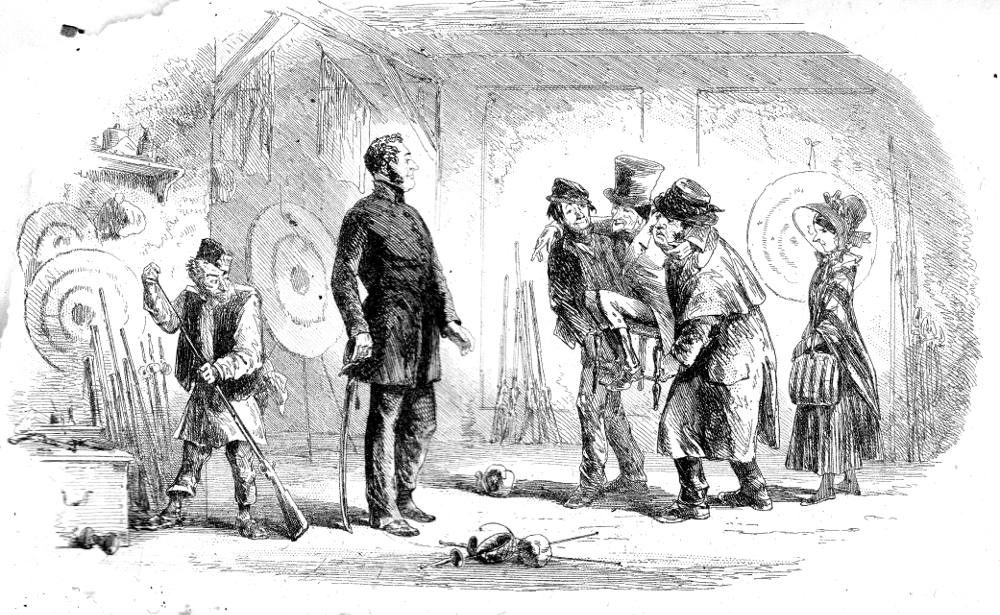
http://www.victorianweb.org/art/illustration/phiz/bleakhouse/18.jpg
"I have come down" repeats Grandfather Smallweed , hooking the air towards him with all his ten fingers at once to  once, "to look after the property".(*)

 Scan credit: George P. Landow at   Victorian Web

Stephen Hester will step down from the leadership of RBS this month with a payoff thought to be in the region of £1.6m, according to Wiki, nearer to £6m if you include share options (according the The Mirror).   He earned around £1.2m a year, making £6m over his term in the seat, and took an additional £6.5m in bonuses and pension payments in 2010, after which people started to put pressure on the new government to DO something.

Only, since Stephen Hester was a Conservative donor, they didn't try very hard and as for the Lib Dems, Vince Cable decided to ignore the occasional story he heard, adopting his standard position of hazy old duffer who cannot be expected to remember anything or grasp the significance of it if he does.

At the time of the previous story which featured Hester, it was felt that I had been rather hard on a man who was not in direct control of the insurance group and anyway, was turning round a failed bank. Furthermore a man who knew the difference between right and wrong and had said so in a video interview to the Telegraph. (May be behind a paywall, depending on your usage)
"It is an extreme example of a selfish and self-serving culture which the whole banking industry is tagged with," he said, adding that it was the board's job to ensure that sort to behaviour has no "validity in the future".
It recently emerged that RBS used another special group of which Hester will no doubt claim to have come over all Vince Cable about, the Global Restructuring Group, GRG, with thanks to Felix Salmon at Reuters who has presented the story clearly.   RBS foreclosed loans because it could get more immediate value out of stripping the assets the debtors had put their lives in to.  Using the GRG group, it engineered defaults to give itself permission to help itself to the fruits of other people's labour, selling them a knock-down prices to its own subsidiary, West Register.  

Perhaps unusually in this day and age, the story seems to have bubbled under with the debtors being  unable to form a coherent pressure group. Possibly that is because it is very difficult to distinguish, from the outside, a good business being pushed under by the bank and a bad business which should be stopped before it gets any worse. When stories started emerging in July 2013, RBS and Hester coolly said they could not comment on individual cases, implying that debtors must all be unreliable complainants - and no doubt some of them are.   The Tomlinson Report draws together the method the bank used.  Lawrence Tomlinson also credits an investigation by the Sunday Times and the work of Sir Andrew Large.

Many in the banking trade have counted on this story being too convoluted to grasp  . They have forgotten that Mr Dickens already explained it in 1853.  This year was the 160th anniversary of the conclusion of Bleak House.

In the illustration above, the old payday lender Smallweed has extended rolling credit to Captain George who has used it to buy a shooting gallery. This barely makes enough to keep him and an assistant in tea and bread but earns just enough to keep paying Smallweed his interest. Probably it is a bad business but George is making his payments and trade might improve.

It then transpires George has an asset he was not aware of; he holds a letter from a late friend which can be used as a sample of handwriting to positively identify the writer of other documents and letters.  Smallweed knows to whom that sample has value and he wants to be rewarded for brokering the deal. The only trouble is, George takes advice and is certain that he does not want to be involved.

Smallweed then brings pressure on him because the loan is not secured just against George's own person but the property of his friend Mr Bagnet.  Smallweed demands full repayment, knowing full well that George has no way to do it and must therefore surrender the letter for inspection.  Which he does.

If people are capable of following the plot of Bleak House and how Smallweed manipulates George to get what he wants, they are capable of understanding what RBS was doing.    Shake me up, Judy.

........................

(*) Yes, I know Smallweed says this when he goes to Krook's house rather than George's shooting gallery, but the sentiment fits best.

Sunday, 12 May 2013

Plays of the Century

A pair of plays bracket the boom years of the end of the 20th century.

The first is Glengarry Glen Ross, the David Mamet Pulitzer Prize winning masterpiece which had its world premier in London in 1983.  This is the eve of the spread of the mobile phone and the salesmen in the seedy office do not have them, not even smoothie Ricky Roma.  Consequently they can do nothing when the telephone handsets are stolen. 

In pitiless observation of their language and values, Mamet exposes what they don't want to face; they couldn't do much when the phones were there, either.  They just like to think they can.  The numbers don't stack up; the junk estate they manage to unload on to fools is still not enough to pay for the time they spend hunting for the next mark. 

They like to think of themselves as natural raptors but at that point in history there weren't enough stupid, juicy mice to sustain them.   They believe their Jedi sales skills will work for them so long as they are allocated the Glengarry Glen Ross leads but there is no good reason to suppose that those leads even exist.  

The office manager thinks these leads are what the firm has bought. He has to distribute them to the salesmen who can best convert them in to sales as shown on the competition board. But there is no reason why there should be a pool of convertible leads for swampland. We never know if the land itself is real.  It's possible that the leads are just a mirage the firm has bought. It's possible the firm's owners know it is a mirage and are playing their own game of pretending to have a profitable company.  The only time the leads have a quantifiable value is when they are stolen and palmed-off on to the next desperate re-seller.

The only people who get anything out of it are the Nyborgs, a couple who like having the attention of a salesman and can do so in safety because it doesn't matter what they sign; they haven't got a bean and the contract isn't enforceable.

In 1987, when Oliver Stone and Stanley Weiser created the character Gordon Gekko for Wall Street, they rooted him in the land speculation of the 1970s, when the early-entry gamers had parceled-up and moved on their junklands to intermediaries.  Ten fictional years later, this office is a long way down the pyramid where Gekko is the pinnacle. It is the last step before the weak James Lingk (weak lingk, geddit) who is induced to sign a contract by Roma. No matter what the salesmen think of themselves, Mamet has positioned them at the bottom of the pyramid of losers, unless they manage to find the one bigger loser beneath themselves - and even then, the law will help their prey escape.

Mamet was appalled to find that far from taking the play as a warning, he had accidentally created a feedback monster and that this was used as a training manual.  The latest incarnation is the Alan Sugar vehicle The Apprentice, where a group of young people are encouraged to shred each other for the edification of the viewing public.  Glen Sugar.

The second play is Enron, Lucy Prebble's explanation of the collapse of the company.  Although the dialogue is wonderful it has to do more technical exposition than Mamet had to because of the breath-taking scale of the fraud.  How could something that big be hidden?   Here we see the same kinds of   people, still selling, still voluntarily blinding themselves to economic reality, only now they have a great deal more money because the boom years have persuaded them they are fantastically clever people instead of what is nearer the truth: they have been unbelieveably lucky.

The fictional Ricky Roma gave philosophical soliloquies which justified his actions; the fictionalized Jeffrey Skilling is similarly given speeches with queasy half-truths in them. Bubbles of inflated value have made things such as railway construction possible and we wanted it all to be true .

Prebble wrote a show which is geared for the modern stage using surprise motifs which wouldn't work in film.  Whereas Glengarry Glen Ross is a realist drama, Enron owes more to forms such as Greek tragedy,  a big canvas of tragedy compared to the intimate study of misery.  Mamet takes small people and enlarges them in to monstrous detail, Prebble has to take a huge event and find a way to contain it on the stage.   Alas, you'll probably have to hope somebody stages it near you or buy the script as there don't seem to be any listed productions at the moment.


This week it was announced that Jeffrey Skilling may be able to negotiate a deal which will see him out of prison earlier much earlier than his original sentence demanded.   Although he presided over the biggest bankruptcy in US history, his mistake appears to have neglected to be a bank.  Then he'd have been bailed out by the tax payer, probably still had his job and possibly still have been given a bonus while losing money.