Monday, 30 April 2012

Are you looking at my bird?


Police are arranging protests about cuts to the front line which they say will make their job impossible because they already have far too much to do.  Strange then that two uniformed persons - thought to be officers - were dispatched from Harrow police station for a word with a gallery owner.  (Note: contains an image some people may find shocking. Report: Evening Standard)

An officer happened to see a picture he disapproved of - apparently while he was on a bus - and was able to divert two of these furiously busy personnel from their normal work of catching murderers to argue about classics, or rather, to lean on the gallery owner to take down a picture of Leda and the Swan.  As it happens, they were packing up for a new exhibition anyway.

If the gallery manager, Jag Mehta, gives an accurate account, the visitors claimed that 'condoning bestiality' was illegal, which sounds more like a PCSO making something up on the spot. 

In general, you can condone what you like, providing you don't mind what people think of you. What you can't necessarily do is is carry it out (Sexual Offences Act 2003), distribute it (Obscene Publications Act 1959), or possess a depiction (Criminal Justice and Immigration Act 2008) without the law imposing a penalty. 

The legislation is dotted about rather than consolidated, but luckily the Crown Prosecution Service has written a  useful guide to these offences.  However, there have been cases which alter the matter, which means their guidance cannot be a definitive. Also, the 8 page pdf the Ministry of Justice wrote has vanished, or at least the online copy has. [Update: having trouble with this link which worked for a while and now does not:  Here it is,  maybe it will come back.  Many thanks to the researchers at Backlash.]

The following relies on the CPS guidance on extreme pornography.  They know all about Leda and the Swan
The painting "Leda and the Swan", another example raised during debates in Parliament, would also not be caught by the new [2008] offence, because it would not meet the "explicit and realistic" test.
Established photographer Derrick Santini was sailing very close to the wind under this definition.  His portrayal of the myth may explain why somebody going past on a bus may have got all hot'n'bothered.
Santini’s use of the lenticular process involves photographing a sequence of still images, using live models, which are layered and printed using a special technique, under a ribbed plastic sheet acting as a lens.  This results in a hologram-like effect where the figure within the frame moves as the viewer passes, although not an actual hologram, it is a form of animation where an illusion of depth is created.
Makes a change from those old nudie cards where if you tilt the picture, the lady's clothes jump off.

I'm assuming that the swan and the woman were photographed separately otherwise the RSPCA might have something to say about it - and I'm guessing that what is depicted is impossible. You try training a swan to land in that space.  There isn't a Royal Society for the Prevention of Cruelty to Models. It says something that given a picture of a naked lady and a migratory bird, apparently in the act of congress, the police are worried about the one with feathers.

If you want to see the full set of pictures, they are on page two of Santini's gallery under the heading "lenticular artworks".  The website is full of slow-loading animations.  It might not be easy to explain them if somebody were to ask so they shouldn't be regarded as safe for work, which is a different question from whether they fit within the definition of an offence.

There are plenty of legal disputes to be had here; for example can a theme such as Leda and the Swan come within the second CPS heading?
 That the image is extreme namely grossly offensive, disgusting, or otherwise of an obscene character;
A little offensive, yes, particularly if it is the rape version of the myth but in general the theme of humans and swans getting it on is common. But one of them is only disguised as a swan i.e. at various times in the past it is more acceptable to show a human and an animal rather than two humans.  There are always  people who worry about the sexual nature of the motif in showing any intimacy but only the ignorant have ever misunderstood that it is about sex with animals.  

Besides, it is neither reasonable nor possible to go back through the museums demanding that all the Leda and the Swan versions are hidden in the archives, trying to decide which ones are merely ecstatically affectionate. 

In addition, it was only in January 2012 that a conviction was denied by a jury in R v Peacock.  The material being supplied by Michael Peacock was nasty and fitted within the guidelines of what could be regarded as obscene, so the CPS brought the case under the Obscene Publications Act. The jury did not accept the prosecution case.  Since we can never see in to the jury room, we don't know exactly why, but we do know that this signals that the CPS are mistaken in what the public are prepared to regard as likely to deprave or corrupt.

However, Alex Antoniou of the City Law School points out that all this means is that the Obscene Publications Act may be undermined.  The CPS now uses the newer extreme pornography charges as these are about possession of an image rather its than publication:
prosecutions under the new sections introduced in January 2009 (ss 63-7 of the Criminal Justice and Immigration Act 2008) related to extreme pornographic images have dramatically increased in the last two years: according to the CPS, in 2009-10 prosecutions were brought in respect of 213 offences, whereas in 2010-11 the number of offences reached 995. It is noteworthy that these latest figures released relate only to possession of extreme pornographic images portraying bestiality.
A prosecution under s.63 requires the permission of the Director of Public Prosecutions.  An officer could be in a great deal of paperwork if they didn't check first that the CPS wanted to use a classical theme as a test case - especially the exact one which was quoted in Parliament.  This artwork tests the boundaries of realism by using photography but on the other hand, a moment's thought about swans tells you that you can't be looking at something realistic.

It is reassuring to know that when the Home Secretary cuts the number of police officers, it won't matter because we can just get rid of the two spare ones who go round wrangling with art wallahs. Until then, don't tell them about Europa and The Bull.

Here is a Leda and the Swan pas de deux. There are two things to note: firstly that the male often holds his arm in a swan form. This is to signify that Leda sees a swan but we all know he's really supposed to be a god in disguise.  Secondly, that the bodies echo each other the way birds court.


Friday, 20 April 2012

The Police State of Norfolk

A fracas has broken out over pictures of football strip which got out ahead of the PR gig, and the story is now running in the Daily Mail and on regional television. A fan found pictures of the new strip on an authorized website and re-tweeted them, 12 hours ahead of the official  launch.  The club noticed and was annoyed.  It called the police.

I can understand that the PR wallah who was arranging the jamboree was miffed at having their thunder stolen just before they hawked their wares, but what I can't understand is why the police thought that they had to involve themselves in a civil matter by trying to classify this as within the scope of the Computer Misuse Act 1990.

The essence of our computing legislation is that, like much modern legislation, it is drawn widely because it is impossible to predict the situations in which it might be needed. The onus is on the police and then the CPS to not use it unless they've got a case which is in the public interest.

The wording was deliberately vague; the security services pushed for the Act in 1990 following the quashing of the Gold and Schifreen conviction, so that unauthorized access would be criminalized rather than the method for gaining that access.

The difficulty with this kind of 'no arguments sonny' legislation, though, is the unwritten deal that the state won't use it to get involved in private matters, to settle private or commercial scores or apply it trivially. We don't have a written constitution. Maybe it can't be adequately expressed in writing, but that's the deal and any reasonable grown up understands it. The difficulty is knowing when to refuse to become embroiled because it is just too trivial to be a criminal matter.

Why exactly did the police rush round to a fan's house? This was obviously a case where one is sympathetic then goes to talk to the lawyer before getting involved.   Possibly there was a matter of copyright infringement, but that's a civil matter, not for the police.

The allegation of a hack doesn't appear to have any substance; Norwich FC themselves put the pictures up via the intermediary promoter Emmerson Marketing, who didn't lock the pictures off properly and were amazed when the fanboi found them by looking at their HTML code and seeing the links there, although they were not yet revealed (reports El Reg in the comments).  Whoops.

As for any commercial implications; there aren't any. Norwich got some free advertising for a garment which nobody but its own fanbase cares about.  All the commercial damage came from the police trying to put the frighteners on a customer.

This was a case which was very low priority, and yet the police reacted because the h-word was waved around. Because they are police and not marketing managers it didn't occur to them that if you are planning the launch of a new home strip, in fact quite a lot of people have to know about it - particularly the sponsors, Aviva, who will have approval of everything, the t-shirt printers, the photographers, players and video artists making the promotional material, and the people building the marketing website who need the pictures ready to go.   The idea that a strip is 'secret' is charming nonsense,  a fairy-story which was told to the police, taking advantage of their relative ignorance.

Shirts don't happen by magic. They happen by contract - and contracts are not, in the first instance, a matter for the police.

Let's have a look at the time-line.

April 17 The fan posts pictures on Twitter
April 18 Norwich FC call the fan at 4.30am, then the police.
April 18 The police interview the fan
April 18 PR releases run by interested websites and papers - see below.
April 19 Daily Mail runs the story about the police interview.
April 19 Norwich FC official launch at Carrow  Road, which shows strip with a different style collar and new yellow streak on the shorts

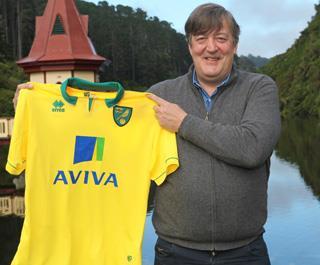
The police seem unaware that Norwich gave the full story and a picture of their director, famous Twitterist Stephen Fry, posing with the shirt on April 18 to the insurance industry website Insurance Times and other websites such as strip suppliers. In order to set that exposure up, they may have given the material to websites on the 17th, who then package it for release on the 18th.

All that happened was a fanboi broke an embargo which didn't apply to him anyway.

Extract:

Aviva extends sponsorship deal with Norwich City to 2016


Insurer will continue to feature on team’s shirts and sponsor Community Stand

Norwich City director Stephen Fry said: “We’re so thrilled Aviva are with us for another four years. A four years which we hope will see our beloved club consolidate its natural home in the Premier League. “The new kit fitted me like a…football shirt. I was so pleased to be able to launch it, even while 12,000 miles away. You’d be amazed how many Norwich fans there are in New Zealand.”

 ........

As Fry explains he is in New Zealand and posing with the shirt, we can safely assume they've been in production for some time, other wise he wouldn't have one and they wouldn't be available to go fresh on the shelves, would they?  This is not 'secret' - it's just that some advertising material was pointed  out to the target market a few hours before the pr launch was scheduled. It's no more than a sneak preview of a product, the soul of gossip.  Nothing whatever to do with the police, who misdirected themselves as to the nature of this complaint.  It's only a 'surprise', the way a new car or a birthday present is a surprise. Fanboi rudely spoilt the "surprise", which is hardly surprising because that's what fans do - they talk about the club.  Clubs generally encourage this because without fans they are nothing.

The Club initially tried to defend its stupidity, then realized it had got it wrong and embarrassed the sponsor, Aviva, who sponsors them to butter-up the customers, not antagonize them .  The very last thing you should do for someone who just paid you a pile of dosh to be associated with a global brand, is draw attention to a minor stuff-up at a PR launch. Norwich FC made their own patron saint Delia look like a cheap thug.  Given Fry's media sophistication and his own enthusiastic use of Twitter, it is most unlikely that he would have run screaming to the rozzers.

The Police State of Norfolk

Someone with clout at the club called the police - was it CEO David McNally? He would have had to be asked first.  Then somebody with clout in the police responded by sending a constable when they should have insisted on taking legal advice first .  Any lawyer worth their salt would have pointed out that a twelve-hour spoiler was not the end of the world and that the first thing to check - politely -  was how the leak happened. It's not necessarily a criminal matter at all.

The question is why did the police act so swiftly?  Was it an example of funny handshakes, the hospitality box and putting the apparatus of a police state at the disposal of a bezzie mate?

That the police mistakenly thought this might be a hack is just about credible.  However, since it took five minutes to explain that the club's promoter had left live links laying around, the correct response is "Sorry to have troubled you Sir, thank you for being so cooperative".  And then tell David McNally that they are satisfied there was no criminal offence and that they wouldn't be taking it any further.

Instead, Norfolk police have ham-fistedly continued to suggest that there might have been an offence if malice had been present, with the poor fanboi being marched around to say sorry as if he could be guilty of something criminal.  This was not a criminal offence at all.  If it was anything, it was for the civil lawyers and not the police.

Norfolk Constabulary are very bad at these matters. They have just spent months being suckered in to the Climate Change debacle, where people mashing up data to suit their agenda have used - or wasted - police time in trying to control and shut down academic dissent. 

Monday, 16 April 2012

Titanic at the Minack Theatre


 Last week I achieved a lifetime's ambition and finally saw a full-scale production at the Minack Theatre.

The Minack is that most English of things which rooted and blossomed in the magical kingdom of Cornwall; a private obsession which chimed with others and called them to itself. Miss Rowena Cade, an amateur producer, offered the use of her garden to the local players for a production of The Tempest. They had done well with A Midsummer Night's dream in a nearby meadow.  The garden of Minack House, however, did not readily offer somewhere to seat the audience.  Cade looked in to what was then a gully above a rock used by fishermen and wondered if a stage could be built down there, where the sides suggested a natural amphitheatre.   Where better to place Prospero's island but on a rock jutting out over the Atlantic Ocean?

Miss Cade and her gardener set about sculpting the theatre and in 1932 The Tempest was performed - by moonlight.  The Times noted the event and a dream became flesh.

That dream was nearly wrecked by WWII, but Cade, who had by now lived through two wars, set about re-building the theatre. She did not know the meaning of  "Give up" but the phrase "The Show Must Go On" was written on her heart and, in most cases, her own wallet.

The theatre is open air - although Cade had some ideas late on for adding bad- weather covers - and that means that you take your chances. All tickets come with a warning to wear suitable clothes and that umbrellas are not to be put up in the auditorium as it intereferes with the view.  In extreme weather they might cancel but normal rain is ignored.

On Monday 9 April the pleasant Cornish spring weather scuttled off to be replaced with bluster and sudden showers of extra-wet rain.  Stopping to pick up a picnic, the lady in the bakery said her friend was a producer and he had called her to say the Minack was experiencing winds sweeping the drizzle down on to the upper terraces, where by coincidence I had a seat to see "Titanic - the musical".   I bobbed over to the sailing shop and explained the situation to the lady behind the counter. She sold me a showeproof suit  and a Frosty Fox snood in a piratical stripe to keep my hair out of my eyes.

Sitting on a rolled-up mat on the terrace, in my survival suit and wrapped up in a waterproof-blanket, I settled down to watch the matinee performance of a lifetime and got it buckets.

The musical has been performed frequently around the world since its slow start in 1997.  This production was by the local Atlantic Theatre Company.  Using an amateur cast emphasises the ordinary lives of many who died rather than the extraordinary lives of  passengers such as the campaigning editor and journalist W T Stead, who perished on the night he might have written his greatest scoop.

An ingenious stripped-down set had been developed to create the bridge of the doomed ship and to focus on the poignant performances.  History records that the night of the disaster was unusually calm; the water was oily flat as the air, although freezing, was static.

The Atlantic was not having this.  This was its big chance to be seen in daylight instead of gleaming in the velvet darkness, and it wanted to be in the performance so it gathered itself in to swollen rollers and flung spray up over the Minack rock below the stage.  The wind hummed loudly over the orchestra,  tugging at our hoods and bringing us a taste of salt.

At the interval the rain started, through which gulls plunged in to the waves, fishing as the incoming tide brought a shoal close to the Minack rock and within reach.   The gulls circle lazily until they see where dinner is, then fold their wings and dive in to the water with a tiny ring of white to mark where they vanish, clean as an arrow.

In the second half the weather threw itself at the performers who continued, cold, soaking wet,  the wind plastering their clothes to their bodies.  This was not historically accurate but it conveyed a sense of impending shipwreck; the sea and the sky produced spectacular special effects but at the cost to the cast of them being only a little warmer than they would have been had they been dunked in the sea that fateful night.

It has been dismissed as grief-porn, this picking over of a century-old civil disaster but that is to miss what even Goebbels - who later commissioned a film about it - realized. The disaster was capable of being read several ways and has been over the century. Jared Poley tells us that in 1912 the dominant theme was that of nature triumphing over man but by the 1940s Goebbels used it to amplify what was true; much British self-confidence had gone down with the ship.

Friday, 30 March 2012

POSH - coming in May


The Royal Court Theatre takes POSH back to the Duke of York’s Theatre, London, from Friday 11 May to Sat 4 August and booking is already brisk for the opening month.

An elite set of Oxford students arrange a private drinking party and startling events ensue.

If staged badly this could be a crude piece of Conservative-bashing propaganda but staged properly it can be a much more complex play, so let's hope the Royal Court rise to the challenge. 

I had the advantage of seeing it at Cambridge, performed by Cambridge students with special insight in to the script. Yes, there is some chippy caricature but they also managed to breathe sympathy in to the behind-each-other's-back stabbing, the ragging - some of it downright hostile - and the insecurity of a generation who cannot rely on the automatic entitlements they once thought the world owed them.   It's also farcically funny at points as this uber-group see their plans for the event work out in a way not necessarily to their advantage. 

An old-money element is the youth who will be expected to take over the crumbling family pile and waste the rest of his life trying to maintain it. "Always the roof" he wails, drawing a sigh of identification from anyone in the audience who has ever had to deal with property maintenance - and that's nearly everybody.

The weakest element of author Laura Wade's thesis is that these students have a unique sense of entitlement, although it was treated as a revelation in 2010 when the play opened.  In fact rather a lot of students think this, Oxford or otherwise. The Cambridge production had an extra edge because of the historic competition between the universities.  They are not the same; not inside and not outside.  Cambridge remains snootier about its intellectual capacities but is otherwise a meritocracy, Oxford retains the underlying tang of social snobbery but has gone to far greater lengths to insist that so long as its entry qualifications are met, all are welcome to apply.

Spoilers sweetie but this is not a comedy. If you haven't seen POSH, grab a seat now and decide whether it is a fair representation of the cabinet, or whether they embody the character traits of the 646 who represent us in the House of Commons, regardless of where they stand on the political spectrum.

Thursday, 22 March 2012

Equus

(c) London Classic Theatre

The London Classic Theatre production of Equus  is part way through its national tour; there is still time to catch it.

But has the nearly 40-year old play has escaped its age? Not every play travels through time, the hallmark of a classic.

The horrifying premise is simple: a teenage boy has blinded six horses to which he was devoted and refuses to say why he inflicted this appalling cruelty. The child psychiatrist Martin Dysart (Malcolm James) has to find out why.

Optimistically - or perhaps arrogantly - both he and the referring magistrate think that the psychiatrist can fix whatever has gone wrong in young Alan Strang's head (Matthew Pattimore).

 
The first sign of age is that in 1973 people apparently had faith in psychiatrists, or at least Sir Peter Shaffer wrote it that way.  I doubt if psychiatrists now would see themselves as quite so confident that they could fix behaviour just by unravelling motives and talking about them, if they ever did.  However, in 1973 such theories were achingly fashionable so an audience would not necessarily have spotted this as a theatrical effect rather than an accurate representation of what a psychiatrist does for a living.

The second difficulty is that one of the formative moments in Alan Strang's life hinges on a chance meeting. Spoilers sweetie - you need to see it because the staging is wonderful - but it is a victim of time.  An event which might plausibly have happened to Alan around 1960 could not happen to the infant Alan in 2000.  If it had, the parents would be shouting about something other than class war.  Our reality has shifted  too much in specific aspects to accommodate the assumptions underpinning the play in 1973.

These, however, are minor quibbles which could be got round by simply setting the play in the past, which as we all know, was another country.  It wouldn't take all that much; Alan Strang would wear flares and a hideous acrylic jumper,  Martin Dysart needs a kipper tie and the lady magistrate should wear a skirt rather than trousers.

Everything else works as it stands because the designer Kerry Bradley has done a bang-up job of  producing a flexible but monumental set which allows the meetings to happen with simple movements and careful lighting and not the slightest delay between scenes, whilst still clearly indicating where changes have happened.   These open sets carry a risk that the audience will miss the signal that a location or times has changed; never once does the set, the lighting or the direction trip over itself leaving the audience behind and thinking "Eh, where are we up to now?"  Moreover, the set is in units which allow it to fill various stage sizes, creating the illusion of a classical amphitheater even in a small space.

For the most difficult query I had to seek an opinion from a Yout of Today.  As Philip Larkin pointed out, sexual intercourse began in 1963 so there had been barely a decade of it by 1973.  A play about myths and sex had great power in those days.  Plays about myths still might, but sex? Can it really still be a credible dramatic motive in an age when you can't open an email account without immediately being offered dodgy products?

Da Yout of Today informs me that it can be, and moreover it has to within this play or else Strang won't play-off properly against Dysart who spends much of the time bemoaning his own arid personal life.

Dysart is the heart of the piece. Ultimately it isn't  the psychoanalysis of young Alan Strang which matters; that's only solving the headline puzzle.  The driving complexity is the aging, raging Dysart, chasing himself about the stage, able to see his own difficulties but unable to do anything about them. Malcolm Jones carries the demanding role with honour, never letting it tip over in to a cartoon shrink but depicting a man standing on the edge of insanity for a living.

Equus is already on the list of the 100 plays of the 20th Century as too are Peter Shaffer's "Royal Hunt of the Sun" and "Amadeus".  Both of those are in historical settings in which the audience automatically colludes with creating another time and place. Equus uniquely challenges the director to keep the play current, not let it slip in to a being a period piece.  This production manages that - it was only me who noticed that the audience had changed - and therefore grab the chance to see it in case we have to wait another 40 years for it to be staged competently.

Here is a surviving dubbed fragment of  The White Horses  (1965, aired in Britain in 1968) which the young Alan Strang was not allowed to watch. It gives a flavour of the aspirations of the time the character was formed in.  

Sunday, 19 February 2012

Sammy Davis Jr.

During the week the name of Sammy Davis Jr. was mentioned and someone said they hadn't realized he was more than a somewhat mannered singer.   This is an easy mistake to make; Britain did not receive the quantity of shows which demonstrated his ability.  Let's put that right now that by thanking the uploaders and his estate who have made  material available so that we can glimpse how this major talent worked and begin to appreciate that he was one of the very best popular entertainers which America has ever produced.

Those who knew him insist that he was in fact the greatest; talented in  an over-arching way that was difficult to see it all at once.

Exhibit one is a section of a 1963 show he did with Frank Sinatra and Dean Martin.  Despite the natural competition between them, they knew who was the talent on that stage.  Sinatra pleads  "What do you waaaant of us?" They go through their joshing and party pieces in the time honoured "Hollywood Party" mode, then at 6:14 Davis produces Marlon Brando.

He doesn't just impersonate a character; he acts it for both good and ill, showing the power but also the incoherence in that style of theatre. Impersonations, my foot. Right there in a tiny link you have a profound critique of the method school of acting; Davis was never incoherent in his life and he's not convinced that it is of any value.  Dammit, this is supposed to be performing for an audience, not modelling.

The Copa Room, Sands Hotel, 1963 part 3


Item 2.  This interview ought to be compulsory viewing for every grunting youth in the land. Pay attention boy, this is how articulacy makes people forget about the looks of the person in front of them. Although Davis regularly joked about race - it was, and is, a major political consideration which can get in the way of a performance - it is known that what he was particularly sensitive about was the glass eye he was obliged to wear after a car accident.  Although he walked in rhythm, it's observably the case that he was no raving beauty. Perversely, that was lucky. A prettier face might have found it impossible to cope with the disfigurement.  As it turned out, people were not all that bothered; they wanted him to joke, to dance and to sing. Luckily, so did he.

Wogan interview with Sammy Davis Jr. 1989 (part 1 of 4)


His signature song, Mr Bojangles, has many versions available. This one is from 1985 and is remarkable for its simple orchestration which never overpowers the poetry. When lesser performers attempt it they misunderstand it to be a schmaltzy tum-ti-tum.  Davis shows that it is in fact an intimate monologue delivered to you, personally.

Mr Bojangles 1985


A Youtube search now shows the major performances of his life and The Estate of Sammy Davis Jr. has archive photography and further material.   In 1964 Ed Sullivan knew he had created a special moment when Davis and Ella Fitzgerald appeared together for him.  He says that when the audience grows up, it will tell its children they saw them perform.  What Sullivan could not foresee is that the recording survived and is here.

Friday, 17 February 2012

Job of the Month - Ferryman

There can be no finer life than to be a ferryman down at St Mawes in Cornwall, moving people across the rivers of the frilly landscape.  One lucky person will be paid to be the Place Ferry Skipper from April to October. 


They are looking for an experienced boat-handler but will provide training and certification for a local qualification.  All you have to do is steer a little boat safely from one side of paradise to the other, taking account of the tides, carrying the tourists and locals while the money-making season is on. 


To get an idea of the job, this is one of the bigger ferries towards the Falmouth side, with a pod of dolphins playing around it.


If you can't pilot a boat, they sometimes need ticketing and distribution staff.

Tuesday, 14 February 2012

StageFright


To the Theatre Royal at Bury St Edmunds for the first production of StageFright by Michael Punter, directed by Colin Blumenau.

Set 1894 during the run of Sir Henry Irving's  "Faust", the action takes place on a night with winter weather so foul that it traps Sir Henry and his theatre manager, Bram Stoker, in an attic dressing room in the eaves of the Lyceum theatre in London.

By coincidence, the temperature on Saturday in Suffolk was -7C during the day and -12C at night, so the audience came in having just experienced the sucking cold of an icy grave.

Bram Stoker was writing Dracula in those days, summoning him up from the influences of theatre, religion, secular philosophy and his own Irish talent - under-estimated by Iriving - so that there seems to be another character, one who never appears, threaded through the work.

It is believed that Irving disapproved of Dracula - he is said to have walked out of a reading and never played the part, although it would have been natural to offer it to him. It is also possible that Conan Doyle saw the pair working and fed that in to his own creations, Holmes and Watson, recognizing it to be much more than a case of an employer and a technical manager.

Irving  was a self-made man and he knew exactly what he was doing; creating effects on the stage. Even his name was partly an illusion, re-fashioned because it sounds so much better than John Henry Brodribb.   Michael Punter gives Irving all the doubt and superstition which goes with the job of acting no matter how hard Irving tries to stick to rational responses.  If you spend your working life summoning up illusory characters, isn't there a risk of calling up something real, Irving wonders, of speaking the Devil's name and having him answer. Perhaps he is always listening for the invitation, like an actor waiting for his stage-call on the other end of a speaking-tube?

Stuck for that freezing night in an attic, the pair of them begin to discourse on this - or rather, Irving declaims and Stoker sets up the lines for him, because that is how their relationship works. They think they are alone but an empty theatre is never completely empty; you have to be careful what you do, what you say because you never know who may be listening. Could a building record the events which happen in it, Irving muses.  If you ask the staff of Marks and Spencer just a few yards away in the modern shopping centre in Bury St Edmunds they will tell you yes, and the building doesn't even have to exist any more. They still get half-ghosts of monks wading through their sales floor and sinking down staircases which have not existed for centuries.

The snow falls outside and soon Irving and Stoker begin to suspect they are not alone.

The Theatre Royal is an 1819 building, beautifully refurbished for a modern audience, so that this is the perfect intimate place to watch a play which aims to recreate the conventions of Victorian stage and parlour magic.   The set has been constructed to nudge out in to the auditorium, dissolving the line between stage and seats so that we are invited to float in the dingy cluttered room, a spectral presence, as if hovering at a seance table.  This is the world where lighting is by gas; that is the product of science and an advanced economy but gas light is still soft and variable and is delivered in fittings which resemble the old oil lamps.  We are looking in to a dusty jewel-box of enchantment and treasure.

The director and author were adamant; to capture the rich flavour of  High Victoriana it had to include stage illusions which the Victorians would have expected in a theatre they would have recognized. Drama had not yet reached the naturalistic psychological approach which is most common today.  Stoker and Irving squabble about this;  Stoker has all the best technical arguments but Irving's case is made in the play itself; there's no mistaking the jump of the audience when .... spoilers, sweetie.

The premier run of Stagefright is at the Theatre Royal, Bury St Edmunds
From Tuesday 14 February until Saturday 25 February
Tickets cost between £8 and £20 depending on seat and performance, bookable online (scroll down and select date).

For some locations in Suffolk, the theatrebus deal is available which includes transport, the ticket, a drink and the programme.  All tickets: £23  For under 26’s: £11.50

Concessions are available including the £5 on-the-day for under 26 year olds, but must be booked via the box office: 01284 769505

The performance is suitable for anyone over 8 years old but is genuinely frightening.

Friday, 10 February 2012

Chymorvah Appeal ruling

Allsorts disappointed with ruling
Peter and Hazel Bull of the Chymorvah Private Hotel in Marazion have lost their appeal to treat civil partnerships differently to marriage as a matter of religious belief.

Full ruling -  Bull & Bull v Hall & Preddy

This means that while the Bulls cannot refuse to have civil partners sharing a double bed,  exclusively gay hotel owners will rely on there being no specific cases which challenge their own blatantly discriminatory practices.  

A marketing term applies here; "gay-friendly" hotels are hotels which reassure guests who happen to be gay that they are welcome. "Exclusively gay" hotels are a significant niche market which specializes in welcoming guests who are gay. They are usually run by hoteliers who are also gay. They exclude other other guests on the basis of sexual orientation and/or gender. It is not clear that this has been legal for a while now, but there has been no significant challenge to the practice, only to some of the advertising.

The popular Pride Lodge in Blackpool advertises
Pride Lodge offers '4 star' accommodation specifically for the LGBT guest and their friends. We do not masquerade as a Blackpool Gay Hotel, we are exclusive and choose not to accept bookings for families or Stag and Hen parties,
So Pride Lodge does not accept a) heterosexuals (unless perhaps you are a friend of an LGBT person) and b) married heterosexuals. It believes it can treat people in civil partnerships differently to those in marriages - precisely the opposite of what was intended in law, now clarified in the Chymorvah case.

Hamilton Hall in Bournemouth is run by John Bellamy, offering specialist retreats exclusively for men; there is an emphasis on gay men but the hotel says that it will accept bookings from heterosexual men.  It wasn't him who worried about the Chymorvah's inconsistencies:
"Political correctness is a doctrine, fostered by a delusional, illogical minority, and rabidly promoted by an unscrupulous mainstream media, which holds forth the proposition that it is entirely possible to pick up a turd by the clean end."
Bellamy apparently understood the danger and intolerance of the Chymorvah case but perhaps was poorly quoted in February last year:
"We've been campaigning for this law for years so that everyone is equal, but it could spell the end of gay-only resorts."
Well then, maybe either stop campaigning and accept that if you want to discriminate, the others will have to be allowed to as well. 

Bellamy immediately went to the Equalities and Human Rights Commission (EHRC) for legal advice.  They say they won't prosecute him - because it is alright to discriminate if you are gay but not if you hold religious beliefs -  ands since they can veto these cases they can probably prevent anyone else suing him.
Hamilton Hall is also the first men only hotel in the UK to be investigated by the Equality and Human Rights Commission and be allowed to continue being a MEN ONLY HOTEL. 
In a similar vein, Guyz Hotel has changed its wording which used to specify that the hotel was exclusively male and exclusively gay, so that now is by implication. Except on the nudist weekends where you can be gay or bisexual but must be male. And naked, thus bringing it with the possible exceptions.

Key West in Torquay is an entire resort which is exclusively male, gay and bi-sexual i.e. it discriminates against exclusively heterosexual men, and women.  It does this by bringing itself within the definition of a private club.
At Key West Resort our ethos is to provide a safe and enjoyable environment for Gay and bisexual men. In order for us to achieve this Key West will operate as a Private Members Club. To use the facilities or to stay at the resort it is a requirement that you fit the criteria of the membership, Gay or Bisexual Male, you will be required to sign an acknowledgement (or tick the accept box when booking online) that you have read and agree to the membership rules.
A gay club can refuse to allow heterosexual married Christians in at all by calling themselves a club, but a Christian heterosexual hotelier cannot refuse to allow a pair in a civil partnership to share a double bed. Can you agree to be discriminated against?  That surely does not give  protection against the legislation. Maybe Chymorvah should just make it clear that it is private members club.

In the year since the original  Hall & Preddy v Bull & Bull case there has been a subtle change on the websites and marketing.  It is still clear which are the exclusively gay hotels but some of them have become reluctant to be identified. The case has done nothing to help them openly promote their businesses, which have had to go back to the days of people knowing which were the gay places and which not.  Cliff House in Devon has been established as a gay-owned, gay-clientel hotel for forty years now, but does that mean it will refuse bookings from hetersexual couples? It is difficult to tell from its gallery which includes things such as "Gareth's Mum's Wedding".

What should have worried the EHRC was that both the comments in Pink News and a balanced piece by Nelson Jones in the New Statesman  lacked sympathy with the prosecution.  It is obvious to anyone who isn't a lawyer that what matters is everyone making a living and everyone getting the hotel room they want.  That is best done by tolerating the inconsistency on both sides. The price for gay hotels is the very modest one of a couple of insignificant private hotels which are barely any different from the Pink House in Brighton.  They just all operate slightly different exclusion criteria.  Goose. Sauce. Gander.

There are female hotels too.  Hitherto a smaller sector, they may appeal to gay women but the overall sense is of refined gentility which relies on nicely brought up ladies not wishing to bump in to wuff gentlemen in the corridors.  The demand for this is growing. You would not worry about your daughter or your granny using these exquisite rooms; they might also appeal to ladies of very orthodox religious views.  Overall there is more tolerance of this version of discrimination but the growth in the service has become controversial as business hotels begin to reserve corridors by gender - and may refuse a booking from a man if there are only 'female' rooms left.

The irony is that while the Chymorvah hotel in Marazion found itself in the middle of a fight because it refused entry to two men who happened to be civil partners,  the original claimants Hall and Preddy didn't rock up to the beatiful women-only  Chymorgen on the North Cornwall coast only a few miles away and demand to be let in.

Apparently they don't mind being discriminated against on the basis that they are men, but they do mind that a pair of Christians won't recognize their civil partnership as equivalent to marriage. 

It is, and was, always about trying to force the public, and especially the orthodox Christians,  to accept civil partnership as marriage, which is why Hall and Preddy went to Chymorvah and not Chymorgen. 

....

Earlier link: Marriage a la mode - Popcorn

Sunday, 5 February 2012

Inside PR and Corporate Communications - Part 3

Corporate Complications
A guest post by Submariner

Being respected only to the extent that you are feared is pure Tucker, but it’s not good for the long term for a retailer. People always have a choice. If the rejection of your plans for a new store in Little Binding is felt by half the town to be a victory for local democracy against the forces of oppression, you’re well on the downslope and it’s time to short the shares. The Tucker doctrine puts you on the opposite side from your customers. In the case of the Tesco crew, they are even on the wrong side of the Blair backlash.
In business and politics alike, times are hard. In the post-bubble economy everything feels like a crisis, and in a crisis the feeling is that anything goes. It’s only human nature to want the comfort of a mythical deadly PR assassin on your side.
But out among the reality-based community, it is not going to help. This is no time for smoke and mirrors, no time for bluster.
The best corporate communication is when the audience sees the business, not the spin apparatus. If you want long term support, take your pain when it’s due. Be frank with your employees, customers, and lenders. Guide expectations to where you think they should be, realistically. Don’t try to put an unrealistic gloss on your losses or revenue reductions.
Educate people about what you can and can’t control in the market. Your business may well be affected by snow, the electoral cycle or the Japanese tsunami, but don’t look as if you’re asking to be excused. Say what the effect has been, when it will drop out of the numbers, and what (if anything) you’ll do differently in the future.
If customers, employees, investors or other stakeholders feel they are being spun a line, they will not give credit even for actual performance and good works. What they will respond to is meaningful management action, backed up by solid facts, good listening and a sense that there are overlapping interests between them and the organisation doing the communicating. No-one ever won trust through intimidation, and fear paralyses better than it motivates.
What politics and the corporate world need more of is the anti-Malcolm. The best communicators are those who concentrate on gathering proper evidence, telling the truth, helping people inside and outside to accept and understand reality, and using their own understanding of the world to help the business make the truth better over time.
Yes, yes. I know. No-one wants to hear that now. It’s all so Pollyanna, enough to make you puke. Hand me the Malcolm mask, and the Profanisaurus. I’m off out to get a job.


Part 1 - A Tucker of your own
Part 2 - Life Imitates Art

Saturday, 4 February 2012

Inside PR and Corporate Communications - Part 2

Life Imitates Art
A guest post by Submariner

Consider. In The Thick Of It, the ineffectual DoSAC head of media relations, Terri Coverley, had been recruited from a popular retailer in an attempt to make government more business-like. She was out of place, a transplant, and struggled with the transition.

But more recently the flow in the real world has been the other way. Political spinners have been whirring out of the Westminster mother ship and planting their seeds in the nation’s commercial boardrooms. They may come from Tucker’s other-worldly culture but their influence in more earthly businesses is now firmly cemented.

Just before Christmas, ASDA, a business which used to have its feet on the ground, hired Sian Jarvis, until recently top spin doctor at the Department of Health, to open doors in government and keep the media in their place.

Later this month Abbie Sampson, ex DEFRA, DfT, Gordon Brown adviser and currently Number 10's chief press officer, will become head of news at Which?

Also in February Tesco, which has long liked to be scarier and shoutier than anyone else, will make room in its nest for Ruth McAllister, a current Number 10 press officer.

Tesco was an early pioneer of the Tucker approach. The company’s Alien Queen of Spin is Lucy Neville-Rolfe. Before pitching up at Tesco she did the lot in the Westminster village: DEFRA, DTI, Cabinet Office, Number 10. And she has established a fully-functioning hive. McAllister will be jostling for elbow room with previous Number 10 veterans: news manager Tom Hoskin,  Tony Blair's former private secretary David North, and Blair’s former head of events Victoria Gould. 
Tesco plays the PR and politics games the Tucker way. For them, it’s not enough to win. The other side has to lose, and lose badly. Tesco’s campaign machinery for imposing vast new colonies stores upon the peasantry has been brutally effective over the last 15 years, but some time over the last decade they smashed the office mugs and retired the mouse-mats with “Every Little Helps” and went instead with "Look on my works, ye mighty, and despair". 


Yesterday - Part 1  A Tucker of your own

Tomorrow - Part 3  Corporate Complications

Friday, 3 February 2012

Inside PR and Corporate Communications - Part 1

A Tucker of your own
A guest post by Submariner

Malcolm Tucker, the hard man of government PR in TV comedy triumph The Thick Of It, is not based on BadAl Campbell after all. At least not according to Peter Capaldi, who plays him.
For a fictional character, Tucker has had a remarkable cross-over into real life, or what passes for it in the worlds of politics, the media, and senior business management.
When Capaldi visited Number 10 a couple of years ago he was amazed at how many government PR people wanted to be photographed with him, despite the bullying, the bad language and the general brutality. I wasn’t amazed. Tucker is superbly written, and superbly performed. You can’t take your eyes off him: he dominates the screen. And for all his faults, he is funny, a relentless stream of cruel wit cutting down all barriers in his path. Who would not love to be able to do that sometimes?
What began as a gargoyle has become a recruiting poster. Tuckermania is now more than a fad for its fans. In interviews Bad Al himself has been careful to align himself with Tucker’s energy, determination and ability to turn the air blue. He knows the glow of reflected glory. But, alas, Machiavelli, alack Armando, satire can be dangerous.
For a while now, the corporate world has been passing through the looking glass. It has been seduced by a fiction. It has fallen for the whiff of testosterone, the heroic vulgarity, the aura of dangerousness, and the mythology that you can always control the media through intimidation. If you’re an important CEO, you want a Tucker of your own.


Part 2  - Life Imitates Art

Friday, 27 January 2012

Take three victims

Over at Ambush Predator, a story is being discussed.  A young father (not married) was ruled to be unable to care personally for a child and so the child was released for adoption against his wishes. He reacted violently to this and gruesomely attacked the social worker.

The case may be more complex than if first appears; consider these possible settings.

The same objective fact is settled in all cases: due to injuries, the father is personally unable to care for the child without the help of  a full time nanny or nannies,  which is what  the Queen used when she was unable to look after her own children due to being away on state business. We aren't prepared to fund that for this man so it is argued that it is in the child's best interests to be adopted away in to a couple who can care for her personally.

Story (i) Mr Thug

Drunken lout of 20 starts scrap on journey back from nightclub, having regularly indulged in fighting. This time he receives a thumping which results in a stroke.

The stroke permanently damages his ability to communicate but not his intellectual understanding of speech or his ability to move about. This is quite common with stroke patients. 

The social worker was communicating with the father and that the father understood what was being said.  The man was held fully liable for the attack in court.

However, there is an inconsistency: the child was being removed because it was argued the disability made the young man an unsuitable carer,  but if he was a lout he was in fact always unsuitable, regardless of whether he came off worst in a fight.

Yet we generally do not remove children from the care of louts, including those with a history of crime and making threats.   Maybe we should, but we don't. Or at least, not routinely.  Should the penalty for starting a fight be the removal of a child?
....

Story (ii) Mr Innocent Victim

Young man of 20 is walking home one evening when he is set on by three youths.  The youths shout "Kill Whitey" but despite their colour and the shouting testified to by horrified witnesses, the crime is not classed as racially aggravated.  No other explanation is ever discovered for the random attack.

As before, the youth sustains an injury which results in a stroke and the permanent damage of his ability to communicate but not his ability to understand.   The best interests of the child are thought to lie with being brought up in a much richer household by parents without disabilities.   The social services obtain a court order which sets aside the father's wishes and will exclude him from the child's life for at least the next 14 years, in the hopes that he will drop dead and stop being a bloody nuisance in the interim. Dear Dad, I never knew you.  However, it is still objectively true that he cannot provide for the needs of the child without a full-time nanny - just like the Queen couldn't.

Regardless of his personal qualities and innocence, the child is removed from his life.  He is then blamed for reacting violently to this and it is concluded that because of his violent reaction to a double injustice, it was right to remove the child.

Should the penalty for losing a fight you never started, be the removal of a child?
.....

Story (iii)  Mr Soldier

A young man of 20 is sent to Helmand. He is a professional fighter and accepts that this involves killing people, and it may also mean he is killed.  Blown up by an IED he keeps all his limbs but in falling takes a blow which causes a stroke.  Naturally, he is discharged.

Following the stroke his girlfriend, whom he had intended to marry, cannot cope with his changed prospects and inability to communicate as she would like, and, having her own problems, puts the child up for adoption.

He is refused permission to be allowed to keep his own child on the grounds that he cannot meet the needs of the child without a full-time nanny, and this is neither affordable nor acceptable, even though the Sovereign whom he served did exactly that.  Indeed, Cherie Booth QC employed a nanny to enable her to keep up her legal career when she was married to the PM.  Miriam Clegg and Samantha Cameron have both relied on nannies, accepting they could not give full-time care to their own children. Nobody suggests that either David Cameron or Nick Clegg should give up public office or have their children taken away.

The young man reacts violently, as it is sometimes known for soldiers to do, when it strikes him there is one law for the rich and another for the Poor Bloody Infantry. Is it fair that rich people are able to nominate proxy childcare, but poor people get social workers, solicitors and judges who re-allocate their child? You can buy a lot of nanny-time for the cost of that professional crew. Both the judge and the solicitor will probably have nannies of their own.

Had he not been blown up, he would have continued to tour and be away from the child for considerable periods of time, but he would have been allowed to keep in contact with the child despite the needs of his job (this has been verified only last week in a dispute between a serving officer and his ex-wife).   In general, we do not accept that merely having a job which involves the parent being absent and therefore unable to meet the day to day needs of the child, is automatically grounds for adopting a child away. But he knew the risks and voluntarily went in to this business, as Mr Thug in story (i) did.

Should the penalty for being unlucky in a lawful fight be the removal of a child?
...

It is sometimes argued that The Best Interests of the Child (BIC) must prevail.  Yet analytically it does not, since that would mean systematically reviewing the circumstances of each child in Britain and re-allocating them to richer, better educated carers until the point is reached where no child could get a better deal by moving households.   That is, optimising welfare.

There are calls to do that, but that is precisely why the European Convention on Human Rights defines the family as sacred.  A particular family may be sub-optimal, but that alone is not enough reason to dissolve it.  Besides, it is very difficult to define sub-optimal. I know what I think it is, but so does everyone else, and I bet we don't agree. It is impossible to avoid Godwin's law;  the stricture was set up because the Nazi Family Policy thought it could stipulate the standards of family care.

If Mr Thug is a thug, that may be a reason he should be dispossessed of his children, but Wayne Bishop wasn't. The prisons are full of thugs being visited by their families. The  ECHR upholds the general right to respect for family life.

What has happened in the case of Mr Bould is that the welfare of the child has been optimised allegedly because he got his head kicked in. The plea in mitigation by defender Mr Holt is reported as:
"Any issue of neglect was not intentional. It was the by-product of their disabilities". 
Then again, Bould set fire to his ex-girlfriend's car, which doesn't sound like a by-product of disability but viciousness, nor does pouring boiling water over a social worker.  As the baby appears to have been present, that also introduces a possible risk of scalding the child. He sounds less and less like a person capable of behaving like a responsible adult.

Against that, we are told that he social worker decided to talk to the sister, not Bould, about the last contact meeting. Given that we are told Bould finds it difficult to talk, and the social worker was already late and thereby deprived Bould of precious minutes of contact, was starting to gossip about him the moment he left the room to go to the loo respectful towards a disabled client, or was it designed to humiliate and antagonise him? 

From the test cases we can see that how you call it depends not only on the interests of the child but also the circumstances in which the disability of the parent occurred. In two of these three cases it doesn't seem  fair to punish a victim by having their children alienated from them.  In the third case, it does seem fair, but not because of the father having been injured. Yet in practical terms, the question is always the same: can they look after a child?

Practicallity matters, but it cannot be the sum total of what matters or else the concept of respect for family life is a meaningless mantra.

Sunday, 15 January 2012

Raft Pie

Where the salt water meets the fresh water there is a line in the river. Just above that line is The Republic of Raft, not so much anchored as lazing alongside a ramshackle landing stage, dreaming of gamblers on paddle steamers and fine ladies languidly dipping white hands and long plaits in the water. 

It was the thin days of January but this year the snow had only glanced the surrounding countryside. The Raft itself rarely froze in; its proximity to the salt water kept its path clear for a quick getaway. Dadder Raft insisted that if needs be, the Old Girl - by which he might have meant the either the Raft or Mammer - could sail coastal waters but her days hauling to Holland were probably over.

Mammer assured us little Rafts that she and Dadder had sailed the seven seas, but we rather doubted this as Dadder had none of the compulsory elements of a sea captain. No wooden leg, no parrot, not even a spy-glass or a turtle-neck jersey. Besides, Dadder could swim and everyone knows sailors are allergic to water, which is why they never drink it. Did you ever see a sailor drink anything but rum? Of course not.

School had begun again and we trudged down to the Board School which had its compensations at this time of year. In the corner the Board had provided a hearth big enough for a dragon to live in, surrounded by great iron railings.  Our teacher, Miss Mavis, did not care for being cold so her high-seat desk had shuffled closer to the fire and she chose to conduct as many lessons as possible  with us sitting in a circle on the floor next to it.  The wooden floor was hard on the bum but then again, it was warm to the touch and far, far away from the incomprehensible maths cupboard which shivered far away at the back of the classroom where a disgruntled stuffed badger lived on the top shelf because nobody could think of what else to do with it.  A stuffed adder, quipped Miss Mavis, might have made more sense.

The school caretaker, lumbering along in his regulation blue dungarees and carrying the symbols of his office, a broom and a bucket, came in to the classroom at break time to top up the grate.  Sometimes there would be faint footprints of coal dust as if a Santa had got lost and fallen down a chimney out of time.  Burton Coggles, whose dad had been down a coal mine, said that the caretaker was really Santa and this was his cover job, you could tell because if you looked in the coal dust there were tiny sparkles.

Back at the Raft, Mammer and Baba cuddled up to conserve a little warmth. We did not appreciate it, but food grew scarce in January and Mammer began to choose us over herself.  Her paying work of sewing tended to drop off just after Christmas, so she caught up with repairs, but always there was the difficulty of where dinner was coming from. Or at least, coming from legally.  Dadder was a marsh man, a wet bob, so in absolute terms he could never starve, not even if he ended up eating the roots of reeds - you can, they are edible - but that diet grinds the teeth to nothing. Protein is what you need, and that means a certain flexibility of attitude.

Up river was an Old Empty Water Mill which stood adjacent to Squire Bragg's farm.  The mill housing, the habitable shack at the bottom and the mill pond had been in the care of the Last Daughter of the Last Miller  but she had died and the Remaining Relatives had set to squabbling about the sale of it. For the moment, reasoned Dadder, it was the property of the Estate of the Last Daughter,  not yet passed legally in to anyone else's hands.

He slipped down to the mill pond because it was here that a colony of carp with mouths the size of half-crowns grazed the still surface of the pond. Where there was weak sunlight slanting through the bare branches the carp would sunbathe.  Here, he had laid out a net in the shallows, pegging it down but leaving the mouth slack so that it could be lifted, just a few inches, and instantly create a prison which only the most determined jumper would get over.   Dadder didn't like nets, them being too much in the nature of  'evidence' if the water bailiffs called, but this wasn't the river so they didn't have any authority, not even allowing for the fact that the pond was fed by, and flowed into, the river.

While the Last Daughter had been alive there was no trouble.  She agreed that so long as they shared the catch, and it was purely for personal use, they would harvest what they needed and no more than that.  There didn't seem to be any shortage of fish the size of cats, they took a pair, another grew in its place. That, after all, is the point of a carp pond.  But she was gone and there are flocks of black-coated solicitors who might want to argue the finer points of testamentary law.

Besides, personal use wasn't directly what Dadder had planned. This was a variation to the bargain. His idea was to take a catch to the fishmonger who was would pay cash as the sea boats were not going out so often this month, leaving his slabs looking bare. Carp is all very well but cash is king.

The sun was well up when he slid two of the fish out of the net and into a canvas bag slung under his arm, offering a prayer for the soul of the Last Daughter, and slipped away brushing his footsteps out behind him so that you would never know that so much as a cat had been down to the water.  Reluctantly he left the net laid out so as not to disturb the bed of the pond anymore than it had been, but if someone cared to look they would find it.

The reeds on the lonely riverbank whispered "fisssshhhess" as Dadder slipped by,  lamenting two brothers who would now sleep with the humans. 

Dadder marched past the Harbour Lights, in to the open shop with its marble slab and winked at Mr Baker the fishmonger.  It was a trick of fate that the baker was called Mr Butcher, while the butcher was called Mr Grocer, but then fate has a whimsical sense of humour.  Mr Baker took a peek in to the bag and held up two fingers.  Dadder responded with four, and they closed at three.   The bag was emptied under the counter.  Due to the sensitive nature of the fish they would not appear whole for fear of provoking queries, questions, unwelcome comments, but they would be displayed in neat fillets under no name. If asked, Mr Baker would say "wytch bream".  "Wytch" being another word for "best not ask".

Stopping for a swift ale at the Harbour Lights, Dadder enquired if anyone had seen Squire Bragg and was reassuringly told that he had last been seen taking a train to the Spa, where he intended to sweat out the port and Stilton which had given him gout over Christmas.  While the Squire was away his man was taking it very easy so he shouldn't be about much but was probably going to be on the dominoes team that evening. Dadder nodded his thanks, which might duly show up in the form of a few coneys liberated from under the Squire's hedges, a form of pest control for which he didn't charge the Squire and didn't trouble him with the knowledge of it, neither.

The bar shut shortly, the landlord being a great believer in late lunches for landlords, and Dadder took himself over to see Mr Grocer -who had now opened after his own lunch - where he handed over a note written in Mammer's italic script: "1lb of minced beef, please".

That was nearly all the business of the day so Dadder hurried back upriver while there was still light and pulled out the last of the potatoes from the sack in his shed and two onions.  Not much to work with but in the sea-locker Mammer had a tin of tomatoes and there was a dab of butter and a drop of millk in the cool tin which nestled beside the boat.

Ahead of the return of the little Rafts, ravenous from school, Mammer fried the beef in its own fat, then the onions and tomatoes, laying them down in a pie dish. On top of that she put the mashed potatoes.  The great metal pie dish was left on the top of the pot-bellied stove, keeping hot and cooking very gently. 

Back in town Miss Mavis had finished reading the class an episode of "Moonfleet" had looked out of the school room window and come to the conclusion that she didn't trust the sky.  It looked grey and sulky, as if ready to pick a fight with the ground.  Swiftly she divided the children in to the believers and heathens, put Leonard the class Jew in to the Wendy House, and whisked the believers through The Lord's Prayer, shooing them out of the door and telling them not to dawdle but to get home before the weather closed in.

Burton Coggles remembered to knock on the Wendy House door to tell Leonard to come out, who answered as if he had been asleep and not listening at all. The Wendy House was made of hardboard with a cloth roof, and not much bigger than a kennel.  Leonard increasingly looked like Alice, growing until she filled up the White Rabbit's house. This impression was inadvertently fostered by Leonard's father who believed in buying shoes with room to grow, so that Leonard trip-slapped about in footwear suitable for an apprentice clown.  

Most of the children lived in the town so Miss Mavis had no concerns for them, but the Rafts had to go along the river bank and she considered them a feather-headed brood, harmless but with less wit than the ducklings on the pond.

She sighed and, regardless of the cold, she gathered her coat, scarf, hat, gloves, galoshes and umbrella - still rolled at this stage - and pointed it to emphasise the way. "Come along children, time to go home" and she marched us smartly down to the path which would become the river bank.  We had to huff to keep up; she was small but she travelled like a determined little tug bringing a liner in to dock.

At the bend of the river, where the water is still salt but you can see the Raft, she stopped and pointed towards our craft with her umbrella. " Run along now, I can see smoke from the chimney and I can smell something delicious."
"Come with us, Miss"
"No dears, I need to get home before the sky makes up its mind."
We ran towards the wisp of hope.
"And anyway" she muttered to herself "there are enough mouths there to feed already".

When we got to the Raft, we turned to wave to say we were alright.  Standing on the raised bank she was outlined against the sky, the wind tugging at the hem of her coat. The pink grey dusk had changed her clothes to the dark bronze of a statue and she rested on her furled umbrella like the knight guarding a tomb in the church. Her hat stood like a heavy circlet on her head.  The line of angry cloud in the heavens held back - or seemed to - while she stood between us and the fated rain.

Miss Mavis looked back towards the Raft, hearing with relief  the distant clink of spoons on enamel plates. On the air was a faint aroma of cocoa telling a story of a voyage from the far Americkees to Holland, but where it came from she could not fathom. 


Sunday, 1 January 2012

Happy New Year 2012


Mr Raft is the most long-suffering of men and since I wanted a fire to celebrate the New Year, he went out in the middle of the night to built me one.   I enjoyed it with a shot of the sloe gin I bottled last year.

Happy New Year

Tuesday, 27 December 2011

Boxing Day Hunt 2011

Certain subjects instantly  provoke a strong emotional response and hunting with dogs is one of them.  

A regular measure now of the support of the the public for hunting is the annual Boxing Day Meet whereby hunters put on a free show on a slow news day.  The Countryside Alliance has gradually coordinated this in to a carnival event.  Masters are expected to make sure that the best riders are neatly dressed outside a suitable pub, the dogs under control, and everybody gets to take photos.  This is about saying to the public "We hunt and we are part of the landscape" and crucially "So are you."

Over to Bedale then, where the fair weather this morning brought a large field of riders and viewers.  The main photographic event was outside the pub with the riders posing with stirrup cups, but just down by the church in a larger field were all the other riders and a crowd well on its way to a couple of hundred.

The dogs were cheekier than expected; one of them rushed in to the CoOp as if realising there was a handy supply of sausages, another lazy dog wriggled under a parked car and settled down for a snooze, hoping not to be seen while the others made the running.  When the pack set off a small wire haired terrier strained on its leash and whimpered pitifully to go with them, called by the ancient sense which even a chihuahua has, that deep in their DNA is still the string which connects them to a wolf.  


Although the hunting with dogs ban  is a nuisance, wasting police time and obliging people to perform legal dances, it hasn't had quite the effect which was feared.  In fact, what with hunt ball tickets selling fast, carol services, calendars of very well-stacked young ladies, sweat shirts, support events and the general opening of social channels, the idea of hunting has never been more popular.  It has thrown off some of its snottier and exclusive airs and has stepped in to a functional niche which used to be occupied by the Church of England.

Whether people mean to get on a horse is as irrelevant as whether they mean to drive an F1 car.  They don't care if someone else does, it is the excuse for the meetings. Hunting is cheap until you saddle up; you can do all the hanging around for a few pounds and that includes having a drink. Or, if you are feeling skint, bring a flask of tea.

For women, hunting has one huge advantage in that it is one of the few sports where a broad beam is regarded as acceptable. Since the riders are under no obligation to be stick insects, nobody else has to either. Hurrah, I'd like cream on that apple pie, thank you.

No doubt it will horrify the old guard and those who don't much care for the riff raff, but the Countryside Alliance has helped the hunts re-position the sport as a socially binding and inclusive activity.  The editorial slant of magazines such as The Field reflect this; articles which would be more at home in Country Living have crept in to justify the cover-price to an audience which, realistically, is not going to buy a gun, a horse or a sporting estate. But they might buy wellies or sportswear such as Dubarry. 

The pressure is gearing up, then, to get MPs to repeal the ban. So far, according to the Telegraph, the government has indicated that it doesn't want to talk about this subject, and you can see why. It's not a deal-breaker from a Conservative point of view. If you mean to vote for Cameron, this issue won't prevent that. However, it might alienate some floating voters, particularly urban women who are a crucial swing group for all parties. There are disputes about how widely supported the ban is, but if legislation were simply a numbers  game, then perhaps we'd be out of the EU and have the death penalty restored by next month.

Unhelpfully, a group of Conservatives - Conservatives Against Fox Hunting - have formed themselves in to a classic circular firing squad and are about to disrupt the current delicate balance by slagging-off their own voters. Turkeys may not vote for Christmas but they definitely campaign for it.  Their 'about' page says:
The Hunting Act 2004 is not about class issues, town versus country, civil liberties or  banning rural customs or traditions.
Yes it is. If it hadn't been, they'd have banned fishing, and even Labour wasn't quite that stupid.

For some reason, CAFH keep quoting Brian May of Queen as if being married to an ex-EastEnders actress and current Strictly contestant makes the science drop-out and popular banjo-plunker an authority on environmental conservation.

What matters is that people who live and work in the countryside - rather than invest in chunks of it from the sale of catchpenny choons - are not cruel, do not deserve to be insulted that way, and thoroughly understand what they are doing -  unlike CAFH.